How agency utilisation and charge-out rates turn your team into profit.. and how to build a team that earns its keep.
In this guide:
- What Broken Resourcing Actually Looks Like
- Who on Your Team Is Actually Making You Money?
- A Players, B Players, and the Ones Quietly Costing You
- Headcount Forecasting: Stop Hiring on Gut Feel
- Subcontractors: When to Hire, and How to Find Great People
- How Do I Recruit A-Player Agency Staff Without Using a Recruiter?
- Getting Visibility Over What Your Team Is Actually Doing
- Common Mistakes
This article is part of the Trimline Agency Profitability Series. For the complete picture, start with Agency Profitability: Why Growth Doesn’t Always Mean Profit
Ready to see what your numbers actually look like? Book a call with Trimline.
Team fully booked, but profit is flat? You’ve got a delivery economics problem.. not a sales problem. The margin is leaking through overservicing that never makes it onto a proposal, a team mix that puts expensive people on low-value work, and charge-out rates that look healthy until a project runs long. Fix those three levers and the margin shall follow.
Key Takeaways
- Get your team to 70%+ utilisation on profitable clients before you think about hiring
- Run Topgrading with your leadership team once a quarter.. focus on the roles with the most leverage
- Pressure-test every hiring decision against the 3.5–4x markup rule and the 50% wage-to-revenue ratio
- Build your recruiting pipeline before you need it, not when you’re desperate
There’s a pattern I see constantly in my fractional CFO work with agencies between $3M and $10M in revenue.
The team is flat-out. Jobs are moving. The calendar is packed. And yet the profit (and cash) at the end of the month doesn’t reflect any of it. Sound familiar?
The instinct is to treat this as a sales problem. Win more clients, grow the top line, that means more money… right? Wrong. More revenue without fixing what’s underneath just makes the problem bigger and more expensive. You don’t fix a sinking ship by adding more crew.
Plus if you try to sell your way out of this, and your team are maxed, you will just burn them out and staff churn will kick up, which often leads to client churn (a vicious cycle).
The lesson: It’s not about how much you invoice, it’s about how much you keep.
This is a delivery economics problem. And the real culprits aren’t buried in a spreadsheet.. they’re hiding in plain sight:
- Overservicing that was never included on the proposal
- A team mix that puts expensive people on low-value work
- Charge-out rates that look fine on paper, but erode the moment a project runs long
Where this shows up is a high team cost, low margin agency.
We’ll cover who on your team is actually profitable, how to spot your A players before capacity pain forces the conversation, when hiring helps and when it quietly makes things worse, and what AI means for headcount planning right now.
1. What Broken Resourcing Actually Looks Like
What are the signs that my agency’s resourcing is broken?
Most agencies only glance at utilisation quarterly.. if they trust the data at all. By the time anyone spots a gap, three months of margin have already walked out the door.
Broken resourcing doesn’t show up as a balance-sheet problem. It shows up as reactive reshuffles, deadline slips, and the same one or two people drowning while others coast.
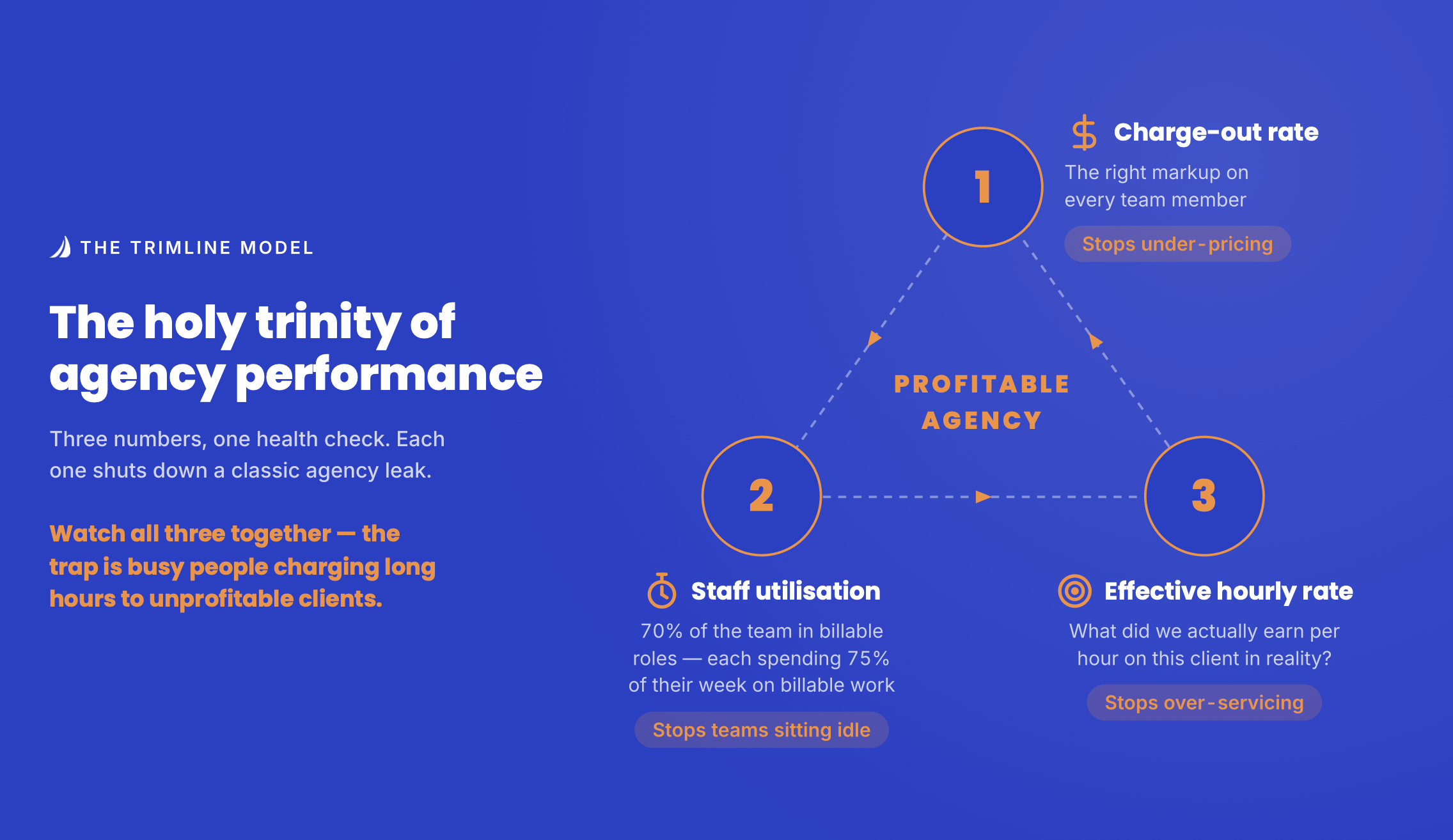
The only real diagnostic is three numbers: billable utilisation, team mix (70/30 billable vs non-billable), and effective hourly rate per client.. and most agencies don’t track any of them consistently.
See below our suggested top 3 KPIs to focus on in this area:
What is a healthy billable utilisation rate for an agency?
In our recent Trimline Indie Agency Report, 76% of agencies were tracking time. But only 41% actually trusted that data. Which tells you something important: the tool isn’t the problem; getting staff to do it is the real challenge.
Average billable utilisation across Australian agencies, March 2026
If you track utilisation, what is your current average billable utilisation across the team?
| Utilisation band | % of agencies |
|---|---|
| Under 40% | 1% |
| 40–49% | 10% |
| 50–59% | 12% |
| 60–69% | 30% |
| 70–79% | 32% |
| 80% or above | 16% |
| Total | 100% |
Nearly half of all agencies are sitting below 70%. That’s below the benchmark for a healthy, scalable business. And most of them don’t know it.
Here are the targets to aim for, by role:
| Role | Weekly billable minimum target |
|---|---|
| Leaders | 15% |
| Account Managers | 50%+ |
| Technicians (doers) | 75%+ |
| Agency-wide | 65%+ |
Billable utilisation targets by role
These are weekly targets for a normal working week. Across a full year, realised utilisation runs roughly 10–15 percentage points lower once annual leave, sick leave, public holidays, and training are factored in. Plan your capacity and revenue forecasts off the annual figure. Not the weekly one.
Why does team mix affect agency profitability?
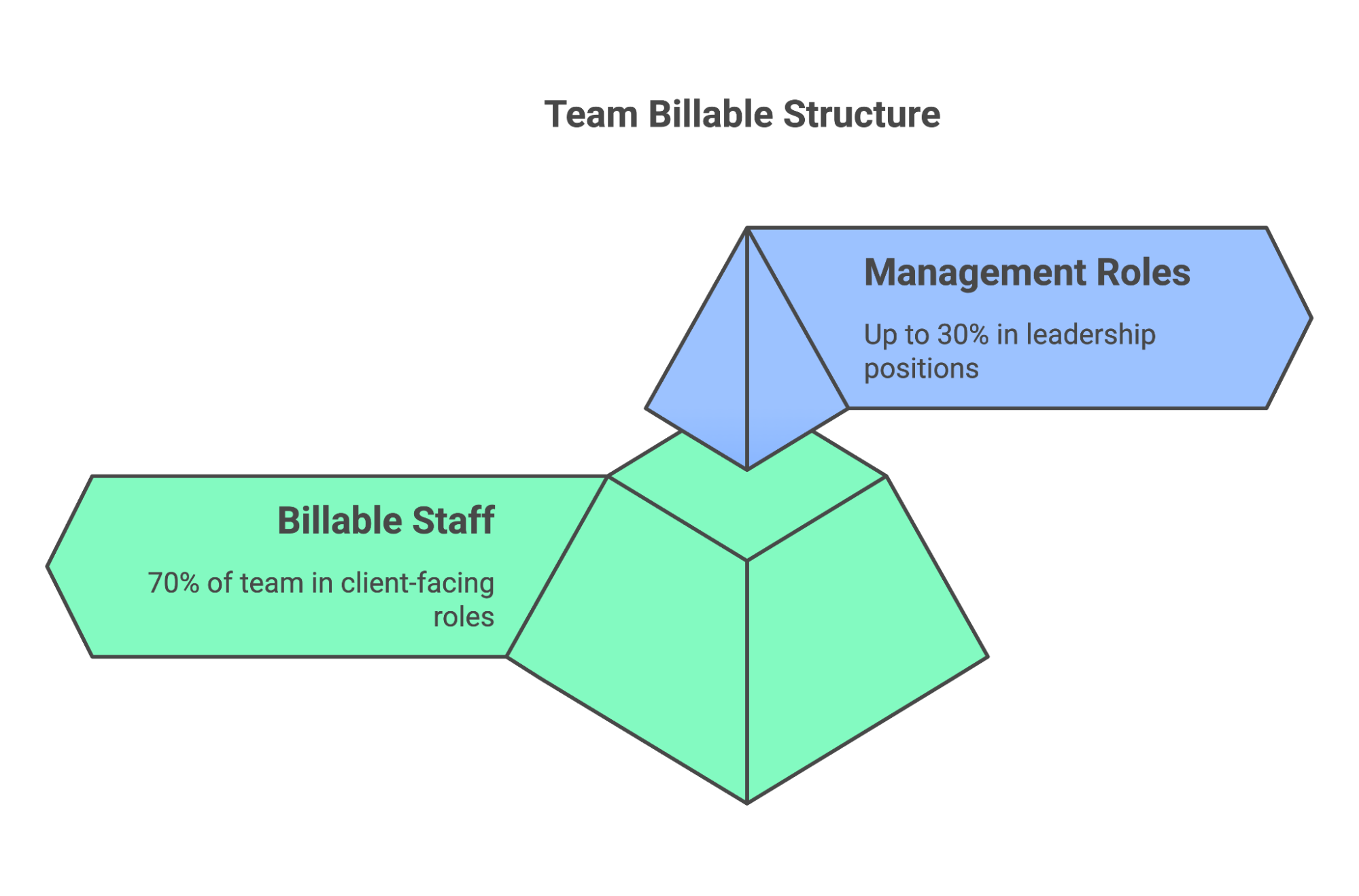
Team mix controls your cost base directly. The 70/30 rule.. 70% of wage cost for billable staff, 30% of wage cost can be non-billable.
The billable staff are ‘paying for’ the wage of the non-billable by directly earning those revenue dollars. If the management layer balloons too large, the model will break.
Same goes if your experienced team members keep getting pay rises but their charge out doesn’t change.
Make sure as many people in the business as possible are billable.. This is why middle management are always the first to be fired in a corporate restructure.
If management is not doing direct billable work, they can still be connected to revenue through driving new business.
Hitting your utilisation target means nothing if the wrong people are doing the billing. Too many expensive staff doing low value tasks and you are overpaying way too much for that time.
They are expensive and should be working on stuff you are charging out at a higher rate to reflect their expertise. Don’t let your high paid staff be tied up in low value work.. it will kill you in the long run.
What is effective hourly rate, and why does it matter for agency profit?
The formula is simple:
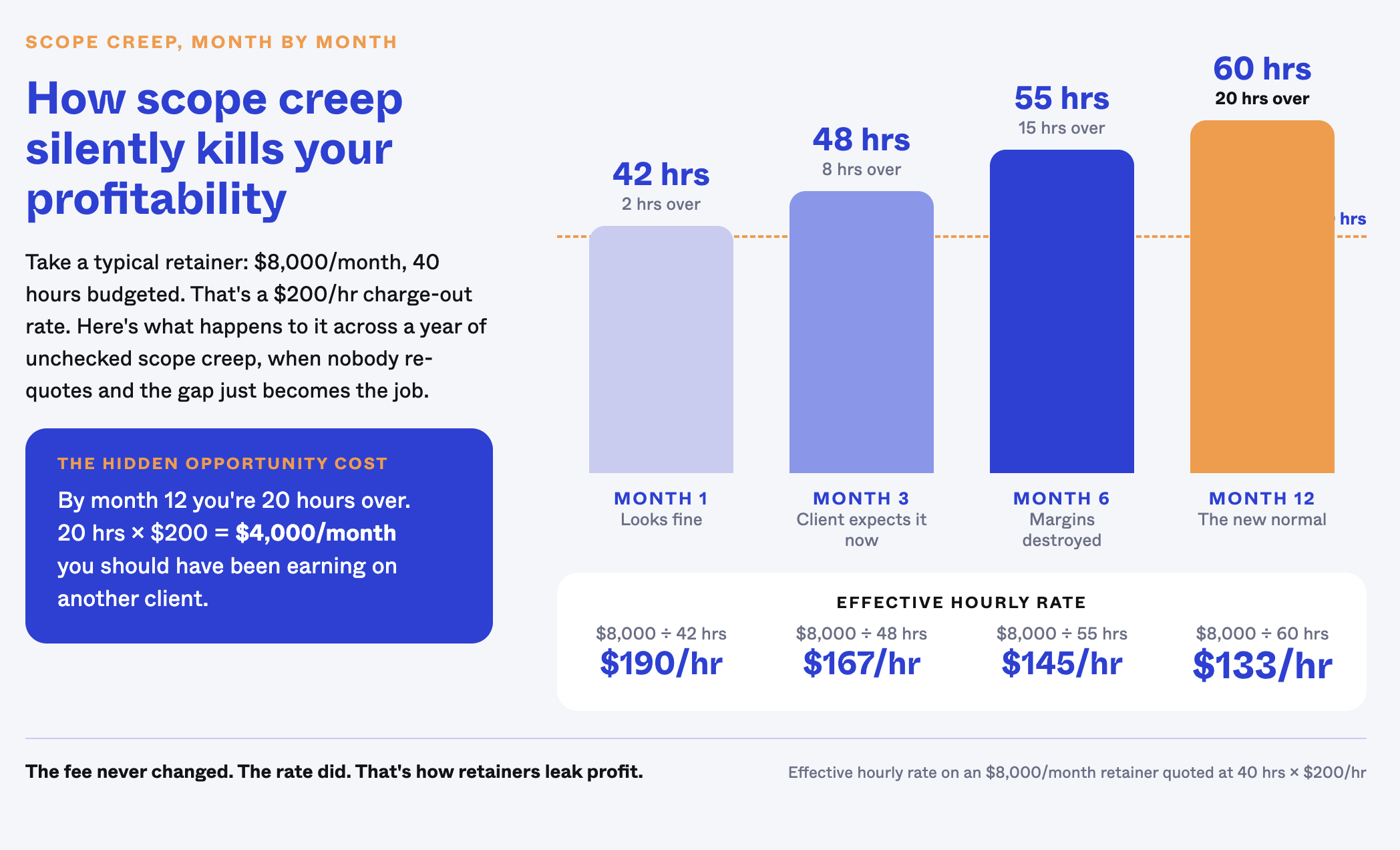
Effective hourly rate = total revenue from a client ÷ total hours worked on that client
Your charge-out rate is what the proposal says. Your effective hourly rate is what you actually earned. A $250/hr rate delivering an effective $140/hr rate isn’t a pricing problem.. it’s a delivery problem. You only see the gap if you track time.
Scope creep, slow approvals, and endless revision rounds are what quietly drag the real number down, even when the work looks fine on paper. Not to police your team, but to connect two numbers that otherwise stay disconnected: what you charged, and what it cost to deliver.
So the full picture is three numbers, not one:
- Utilisation: Is the team billing enough hours?
- Team mix: Do you have the right 70/30 split, with the right people doing the billing?
- Effective hourly rate: Is each client actually worth the hours going into it?
Hit your billable targets and ignore effective hourly rate, and you can be busy, fully utilised, and still going backwards. Profitable agencies watch all three.
📥 BONUS RESOURCE #1: Org chart at scale template
If you don’t track time yet, start by tracking team cost as a % of revenue. Plug your wages into this template and model your team at the level you are at. Most founders are shocked by what the management layer is costing them. Then go one level up and plan where your team is heading.
Trimline // Org Chart & Headcount Planning Template

2. Who on Your Team Is Actually Making You Money? (Introducing the Topgrading Framework)
How do I know which team members are actually profitable?
Most founders think about their team in terms of output. Are they delivering? Are clients happy? Is the work getting done?
That’s the wrong frame.
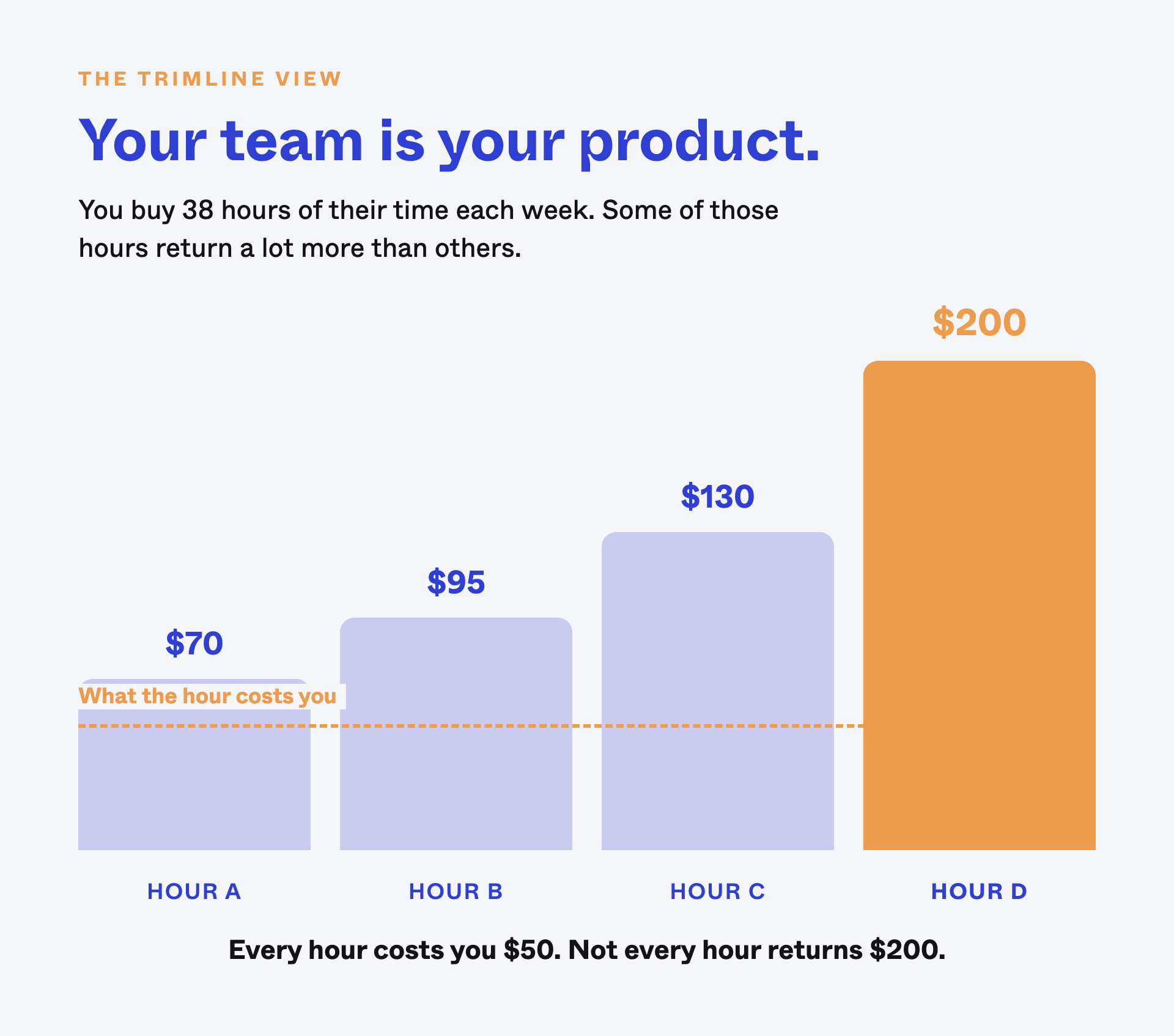
In a service business, your team is your product. You buy 38 hours of their time each week. It’s on you to invest those hours for the best possible return. The same way a product business buys something for $1 and sells it for $4, you’re marking up labour. And some of that labour is returning a lot more than others.
How much does low utilisation actually cost an agency?
Low utilisation costs more than missed revenue.. you’re still paying full wages while billable hours disappear. Drop utilisation and a team member’s weekly profit contribution can fall sharply, even though their salary hasn’t changed. Multiply that gap across a whole team, and it becomes one of the biggest silent drains on agency margin.
If sales dries up, agency founders are often too loyal, and hang on too long before adjusting the team.
The same logic applies to staff who are chronically overservicing clients. You’re still paying full wage for that time.. you’re just not collecting anything for it. The retainer price is already locked in, so there’s no invoice that flags the loss. It’s just money walking out the door that you can’t see.
How do you improve utilisation and charge-out rate together?
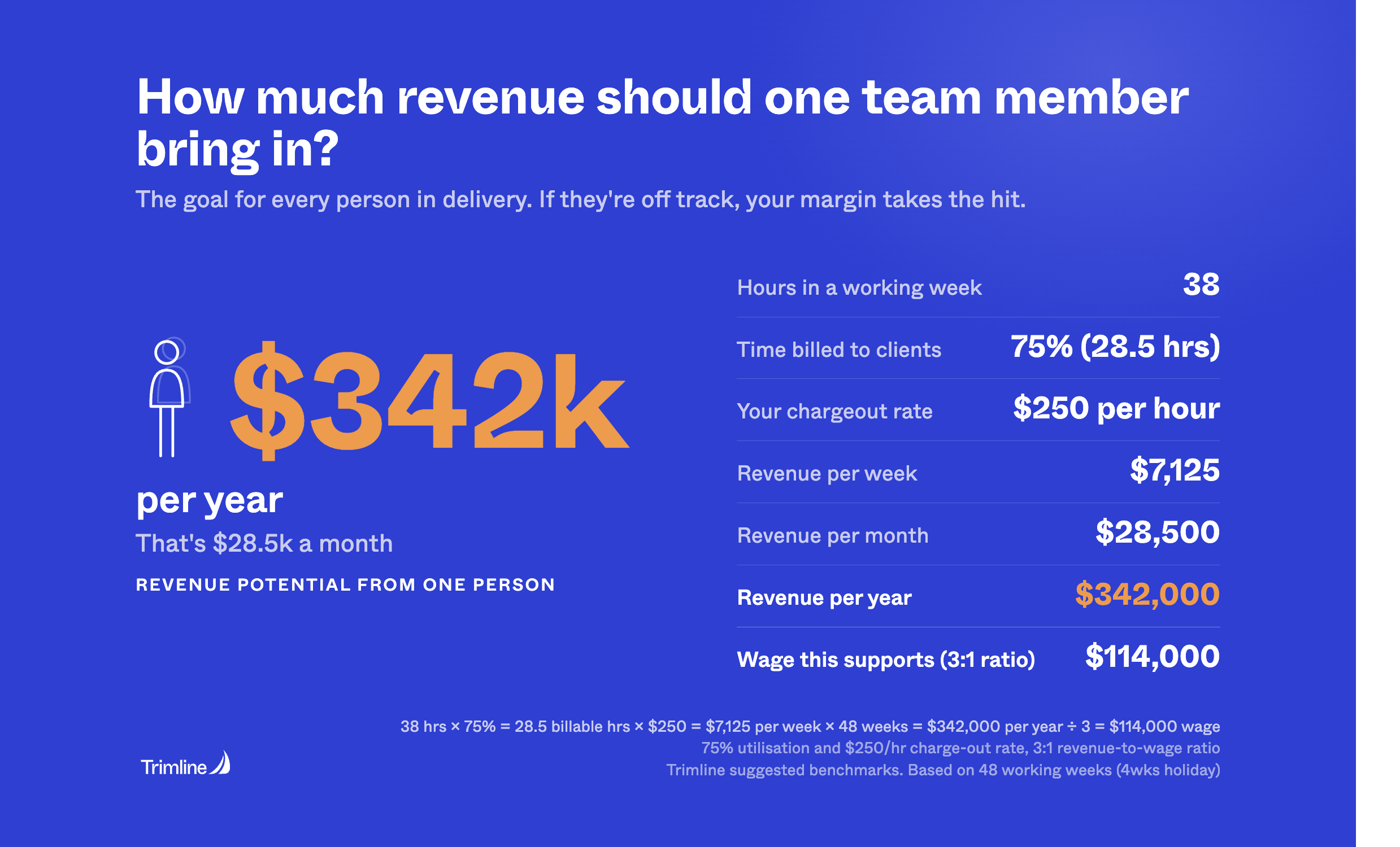
Let me walk you through a real example, because the leverage here is bigger than most founders expect.
Paid media is a brutal market to hire in right now, so it’s a good one to use. Say you’ve got a Paid Media Account Manager on a $120K total package.. that’s $10K a month in wages. Working standard 38-hour weeks, that’s a raw hourly cost of $61.
Scenario 1: Raw hourly cost $61 x 3.5x markup = $213 charge out rate. At 50% utilisation, we earn $16,188 a month. With raw cost at $10K, gross margin on this person is $6,188.
Scenario 2: Hourly rate increase. Raw hourly cost $61 x 4x markup = $243 charge out rate rounded up to $250. At 50% utilisation, we earn $19,000 a month. At $10K cost, gross margin on this person is $9,000.
Scenario 3: Good hourly rate + utilisation. Raw hourly cost $61 x 4x markup = $243 charge out rate rounded up to $250. If we can push utilisation to 60%, we earn $22,800 a month. Gross margin on this person is $12,800. This is basically double what we earned in Scenario 1 on the same person.
| Metric | Scenario 1: Baseline | Scenario 2: Rate Increase | Scenario 3: Rate + Utilisation |
|---|---|---|---|
| Raw hourly cost | $61 | $61 | $61 |
| Markup | 3.5x | 4x | 4x |
| Charge-out rate | $213 | $250 | $250 |
| Utilisation | 50% | 50% | 60% |
| Billable hours (annual) | 912 | 912 | 1,094 |
| Revenue earned (monthly) | $16,188 | $19,000 | $22,800 |
| Monthly raw cost | $10,000 | $10,000 | $10,000 |
| Gross margin (monthly) | $6,188 | $9,000 | $12,800 |
| Gross margin % | 38% | 47% | 56% |
Paid Media Account Manager.. three scenarios at $120K total package
The difference between Scenario 1 and Scenario 3 is not a different person. It’s a better rate and slightly higher utilisation on the same person. Gross margin nearly doubles.
Now apply that across every underperforming staff member in your agency.
The account manager problem:
Keep in mind that account managers are one of the biggest profit drains of any agency. Utilisation is often nowhere near 50%, and agencies often don’t budget their time correctly in their pricing and quoting.
BUT if you can get your account managers working on the right volume of clients.. not over-servicing, not taking (or creating!) unnecessary meetings, adding a lot of value, and upselling.. they can be a huge profit driver for your business.
This has an even bigger impact when a team member can get through current work quicker and take on additional clients, plus spot upsells and keep their client churn low due to solid performance. This is the benefit of A Players.
3. A Players, B Players, and the Ones Quietly Costing You
What is the Topgrading framework, and how do agencies use it?
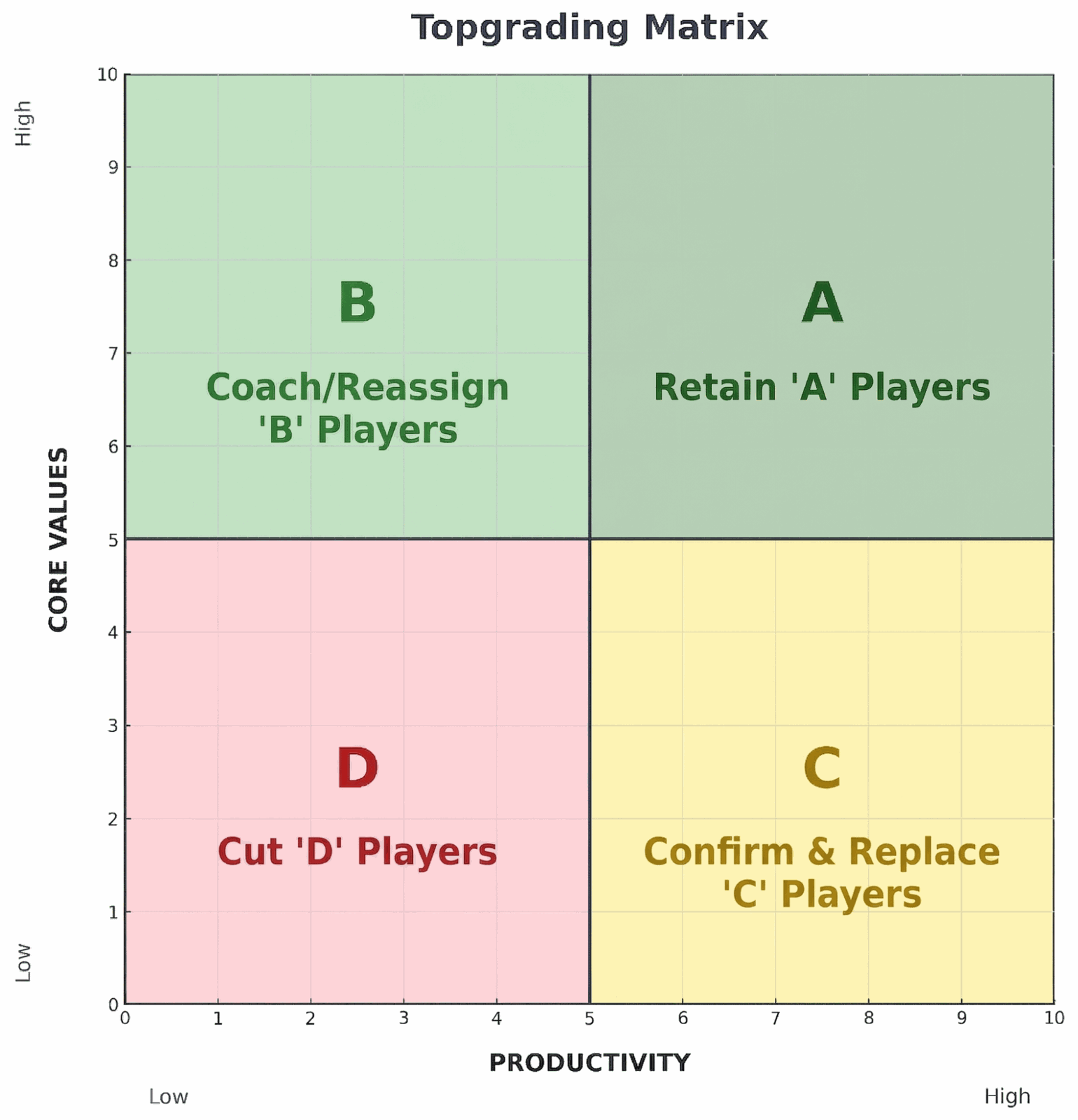
Topgrading scores every team member on two axes: core values alignment (1–10) and productivity (1–10). A Players are high on both.. retain and build around them. B Players are coachable or well-placed. C Players have output, but poor values fit; you can’t coach values. D Players go.
This is where most founders stop at utilisation data and miss the bigger lever. Your goal is to know exactly where every team member sits, then do something about it.
| Player type | Values alignment | Productivity | What to do |
|---|---|---|---|
| A Players | High | High | Retain, promote, build around them |
| B Players | Medium | Medium | Coach toward A, or keep in the right seat |
| C Players | Low | High | Can’t coach values.. usually a hiring mistake |
| D Players | Low | Low | Cut them |
How to use the Topgrading matrix
Think of your team like a sports roster. The best coaches aren’t just managing this week’s game.. they’re constantly asking whether the right people are in the right seats. Not to cut people. To make sure everyone has a chance at hitting their potential.
The Topgrading matrix does this simply. Rate every person in your business.. including founders.. on two axes:
- Core values alignment (1–10) which is hard to train.. often it’s a personality thing.
- Productivity (1–10): their output for the business.
That’s it: two numbers, one conversation, a lot of clarity.
A Players are high on both. Retain them. Build around them. These are the people your business should be structured to keep.
B Players are where most people land, and that’s fine.. but don’t treat them as one group. Some B Players can be coached toward an A with the right investment and the right seat. Others are solid, reliable, and exactly where they should be. Know which is which.
C Players are the tricky ones. High output, low values alignment. The person who’s good at their job and acts like you should be grateful for it. You can’t coach values. Sometimes there’s context.. something going on outside work that shows up as their worst self temporarily. Worth a direct conversation. But if it’s a hiring mistake, that’s a harder call and one most founders leave too long.
The real fix is upstream, in how you recruit for values in the first place. More on that in the recruitment section below.
D Players are low on both. That decision makes itself.
The hidden opportunity cost
You haven’t experienced what an A player in that seat could look like, so you don’t know what you’re tolerating. The most common reaction once a founder finally makes the move? Relief. Not satisfaction. Relief. Followed by: I should have done that a year ago.
The goal isn’t a team of A players.. that’s not reality. A team of solid B players with strong A player leadership is a very good outcome. But anyone in a leadership role sitting at C or D needs to be looked at. And if you genuinely can’t see someone being part of the business in three to five years, it costs nothing to start looking now.

Why do founders keep underperforming staff for too long?
Founders keep underperformers because they’ve never seen what an A player looks like in that role. Once the move is made, the most common reaction is relief, not satisfaction. The second most common thought: I wish I’d done that sooner.
There’s also the loyalty question. Long-serving staff carry real weight: history, relationships, institutional knowledge. That’s worth acknowledging. But loyalty and capability are different things. If you want to get to the next level, you need the people who are ready for it. Some founders are happy where they are, and that’s a legitimate choice. But know what you’re trading.
What does a bad senior hire actually cost an agency?
A misaligned senior hire costs far more than their salary.. in wages, in the good performers who quit because of them, and in the clients who leave. One real example follows below. The damage is almost always values misalignment, not a lack of skill, which is exactly what Topgrading is built to catch.
I’ve seen this go wrong in a way that still stings to think about. A new head of department came in promising a little black book of clients they’d bring across. Talked the talk. Looked great on paper. They started, then immediately refused to touch delivery. Expected everyone else to do the heavy lifting. No clients came across. Existing clients started churning because of them. Turns out they weren’t a people manager at all.. they just wanted the fun strategy work and left everything else to someone else.
That hire cost $15K a month in wages. A high-performing junior, who didn’t want to work under this person, left. Revenue dropped from client churn. The senior was eventually moved on, but the damage was done. Months of momentum gone because one person wasn’t aligned with how the business actually worked.
Run Topgrading with your leadership team. Out loud. Focus on the roles that carry the most leverage in your business.. for good and bad. Different perspectives on the same person are where the real insight lives.
4. Headcount Forecasting: Stop Hiring on Gut Feel
How do I forecast agency headcount without guessing?
Work backwards from revenue, not forwards from busyness. In a healthy agency, total staff cost sits at 50% of revenue.. that single number anchors every hiring decision. A delivery pod should run at 3x revenue to wages; the whole agency at 2x. Hire when the existing team hits 70%+ utilisation. Not before.
The default response to delivery pain is hiring. Most of the time, it’s the wrong call. Founders hire when they feel busy, and feeling busy is not a forecasting method. It’s a gut reaction to pressure, and pressure is a terrible time to make a $100K decision.
What should staff cost as a percentage of revenue for an agency?
In a healthy agency, total staff cost should sit at approximately 50% of revenue. That figure comes directly from the pricing rule applied across a real team, not an arbitrary target. Here’s the maths behind it.
That 50% figure isn’t arbitrary.. here’s where it actually comes from. You mark up a billable hour 3.5 to 4x over what it costs in wages. That’s your pricing rule. But it describes one hour, not a business. Nobody bills for every paid hour.. a healthy team member is billable around 75% of the time, and the rest is leave, admin, and internal work.
So the markup shrinks across a team: a 4x markup at 75% utilisation yields a delivery pod with a 3:1 revenue-to-wage ratio. Then add the people who don’t bill.. managers, sales, admin. Once their wages are in, the whole agency settles at around 2:1.
| Team segment | Revenue-to-wage ratio | What it means |
|---|---|---|
| Delivery pod | 3:1 | Every $3 in revenue is delivered by $1 of wages |
| Whole agency (including management) | 2:1 | Wages = 50% of total revenue |
At 2x, wages are exactly 50% of revenue. The other 50% covers overheads, tools, and profit. The maths doesn’t lie.
What is the four-step method for agency capacity forecasting?
There’s a better way than hiring by feel. Work backwards from where revenue is heading.
- Forecast your revenue for the next 6 to 12 months. Start with signed retainers (what’s locked in for the next 6 months?). Then add 30–50% of your sales pipeline value (not the full pipeline). Example: $500K in retainers + $200K (50% of $400K pipeline) = $700K revenue forecast. That’s your floor for headcount planning.
- Turn that into a wage budget. If staff cost should be 50% of revenue, your wage budget is simply half your revenue forecast.
- Turn the wage budget into headcount. Divide it by the average loaded cost of a team member.. that’s roughly how many people you can carry.
- Sense-check against client load. The money tells you what you can afford; it doesn’t tell you what the work needs. Cross-check headcount against your client list before you commit.
Key principle: The forecast tells you when to hire, not just how many. If revenue grows in month six, hire in month four so the person is ready. Expect the ratio to dip for a quarter while they ramp up.. that’s normal. Plan the cash for it.
Your pricing rule, your utilisation, your team mix, and every hiring decision all feed one number.. staff cost at 50% of revenue. Get that number right, and the rest of the model works. Let it drift, and everything gets harder.
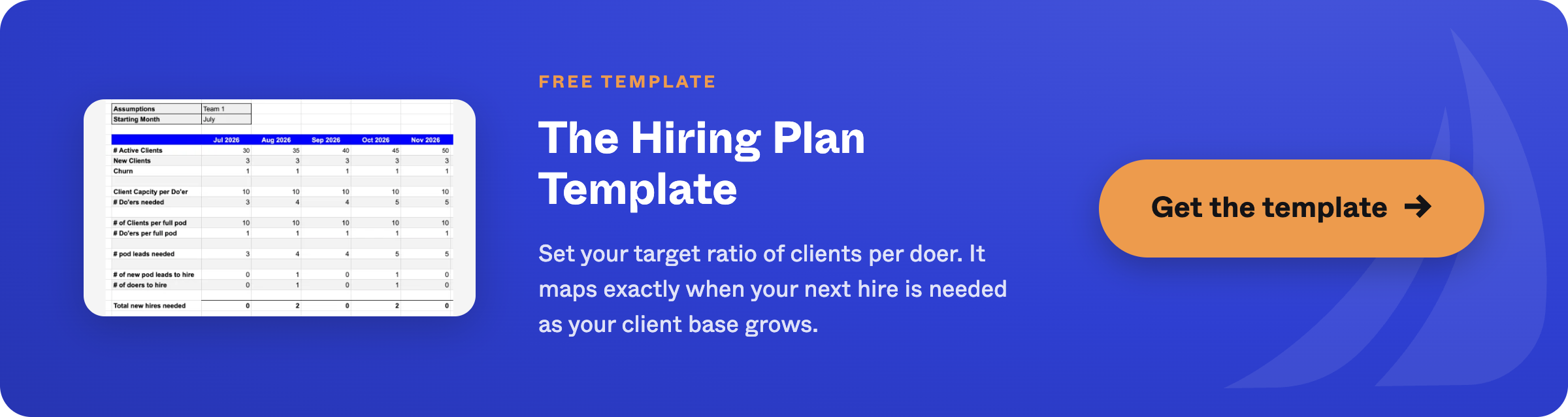
Hiring plan template
Want to put this into practice? The hiring plan below does step 3 and step 4 for you. You set your target ratio of clients per doer, and it maps out exactly when your next hire is needed as clients grow. It is the timing engine that sits underneath everything above.
Work backwards from active clients to doers needed.
5. Subcontractors: When to Hire, and How to Find Great People
What are the risks of using subcontractors in an agency?
Subcontractors are a solid overflow valve.. flexible and fast to onboard. But there’s a risk most founders underestimate: I’ve seen subcontractors leave and take clients with them. Not everyone’s motivated that way, but the pursuit of more money can make people do things they otherwise wouldn’t.
The fix isn’t avoiding subcontractors. It’s having the right contracts in place and actively protecting your client relationships from day one.
Loyal subcontractor relationships do exist. They’re usually built on a long history, fair rates, and clear boundaries. Build them that way, and they’re an asset. Skip the contracts and assume good faith, and you’re exposed.
When should an agency actually hire a new team member?
The rule is simple: don’t hire until your existing team is utilising 70%+ and the margins are where they need to be.
If margins are under pressure and you’re not ready to hire, there’s a quieter option. When someone leaves, don’t replace them immediately. Let the team gradually absorb the work. It layers on responsibility bit by bit, gets people operating at a higher rate, and avoids any dramatic restructure. It’s not always comfortable. But it works.
Only hire when those conditions are met: the team is at healthy utilisation, net profit margins are at least above 10%, and you have at least one month of cash runway saved.
6. How Do I Recruit A-Player Agency Staff Without Using a Recruiter?
Most founders only recruit when they’re desperate. That’s the worst possible time to make a hiring decision.
When you’re underwater, you lower the bar. You hire fast. You hire wrong. And six months later, you’re managing a performance issue instead of running your agency.
The fix isn’t a better recruiter. It’s treating recruitment as a continuous background process, not an emergency response.
What are the best recruitment channels for agencies that don’t want to pay recruiter fees?
Let’s be clear.. a good recruiter who can find you an awesome team member is worth every cent you pay them. Recruiters fill a valuable role in the jobs market. But as a CFO, the fees do sting, especially for expensive hires. Most agencies use both strategies.
They have a trusted recruiter, like Creative Natives, who they use to find talent, but they also look at themselves as well. Here’s where to look:
| Channel | Best for | How to use it |
|---|---|---|
| LinkedIn direct outreach | Senior hires | Personalised founder message.. more effective than any job ad |
| OnlineJobs.ph | Offshore roles (admin, ops, support) | Deep talent pool, lower cost base, long-term team members |
| Direct headhunting | A players who aren’t looking yet | Coffee, stay in touch, plant seeds 6–18 months early |
| University relationships | Entry-level pipeline | Interns to staff pipeline, never scrambling for junior talent |
One more thing on channels: be careful what you call the role. The job title filters your talent pool before you’ve read a single CV. Name it too narrowly and you screen out people who’d be brilliant at the work but come at it from a different angle, or who’d never picture themselves under that label. Cast the title wider, hire for the raw attributes, and train the specific skills. Skills are teachable. The attributes underneath them mostly aren’t.
I’m growing fast. Should I hire agency staff one at a time or in batches?
If you are going through a growth period (well done!) and need two or three people, hire four. CVs can be polished, interviews can be rehearsed, but probation can’t be faked. A batch hire turns your probation period into the real interview, and the numbers game means you keep the best two or three instead of hoping your one pick was right.
Here’s the logic. Anyone can write a great CV. Anyone can nail an initial conversation. You can run two solid rounds of interviews and still hire a dud. The only data that actually matters is how someone performs in the seat, with your clients, under your systems.
So when you’re hiring at volume, flip the odds. Bring on four when you need three. They don’t know they’re in a competition, but they are. The real world does the filtering that no interview process can.
This matters most when you’re scaling fast. If you need to fill six seats at once, the chance of landing six A players in one recruitment round is close to zero. You have to kiss a lot of frogs. Batch hiring builds that reality into the plan instead of pretending your interview process is smarter than it is.
Two catches. It costs more in wages upfront, so plan the cash for it. And you need enough real work in the pipeline for everyone to be genuinely tested. A batch hire with nothing to deliver tells you nothing.
Score the batch against the same Topgrading matrix from earlier in this article. Values alignment and productivity, out of ten each. By the end of probation, the decision usually makes itself.
How do you hire for values, not just skills?
You can’t coach values, so you have to hire for them. The method: get clear on what your agency’s values actually are, then work out what evidence would show up in someone’s history if they genuinely lived them. Then screen for that evidence, not for claims.
Every candidate will tell you they’re collaborative, curious and driven. The words are free. The evidence isn’t.
If you value giving back, look for volunteering or community involvement. If you value curiosity, look for people who’ve taught themselves things nobody asked them to learn. If you value drive, look for competition somewhere in their life: sport, side projects, anything with a scoreboard. If you value adaptability, look for people who’ve travelled or worked across very different environments.
The specific indicator depends on what you’re hiring for. The principle doesn’t change: past behaviour is the only reliable signal. Someone who has never displayed a value in their own time isn’t going to suddenly develop it on your payroll.
There’s a second layer that makes values actually work day to day: operating principles. A values poster that says “freedom” or “respect” doesn’t help a new hire make a call in a grey area. An operating principle does. Think of it as a decision-making algorithm for your business: in this situation, here’s how we think it through.
Some of my clients have replaced their values list with a set of operating principles entirely. When a new hire hits an ambiguous situation, a client asking for something outside scope, a judgement call with no obvious answer, they run it through the principles and one of them resolves it. That’s values you can execute, not values you laminate.
Write your principles down before your next hiring round. They sharpen your screening questions, and they cut ramp-up time once someone starts, because the new hire can make decisions the way you would without asking you.
How do you train new agency hires faster to increase profitability?
The faster a new hire is doing billable work, the more profitable they are. One approach: hire a sharp junior, bring in a subcontractor to train them, and have the junior document the process as they go. Costs more upfront, but you get senior-level output on a junior wage, plus documented IP.
Hiring A players is only half the equation. What happens in the first 90 days is where most agencies underinvest, and it’s why new hires take so long to ramp up.
Where this works well: paid media hiring, for example. The market for performance marketing staff is competitive and wages are high, so a senior with all the IP is often out of reach, and most founders are too stretched to train someone from scratch themselves. Applying the approach above here still means paying both the contractor and the junior for a period, but that’s the trade-off for building capability without blowing the wage budget.
What is the right mindset for agency recruitment?
Recruiting isn’t an event. It’s a constant, low-level background process that the best agencies never switch off.
The best people aren’t looking. They’re employed, well paid, and delivering somewhere else. No job ad reaches them. The only way to hire them is to already know them when the seat opens up.
The founders who always seem to find great talent aren’t lucky. They’ve been quietly building relationships for 6 to 18 months before they have a vacancy. Coffee catch-ups. Genuine interest in someone’s career. Helping people along with advice and connections, with no immediate payoff. By the time the seat opens up, they already know who they’re calling, and that person already trusts them.
There’s a bonus to hiring known quantities: someone you or your network has actually worked with carries far less risk than a stranger with a great CV. Loyalty tends to come with the relationship too.
7. Getting Visibility Over What Your Team Is Actually Doing
How do I get visibility over what my agency team is actually doing?
Most agencies have time tracking software, a project management tool, and a spreadsheet, but no single place that shows the truth. The fix isn’t a bigger tool stack, it’s picking one team to track and rolling it out through a short pilot, both covered in the next two questions below.
Most agencies have all three tools. Almost none have one place that pulls them together. A project running a few hours over here. A client absorbing more attention than they’re paying for there. Neither shows up until the month closes.
How do you start tracking agency team utilisation from scratch?
Start small: pick one team or one client, log hours as billable or non-billable, and calculate utilisation weekly (billable hours ÷ total hours worked). Harvest and Toggl are the two best entry-level tools. The buy-in conversation with your team matters more than the software.. frame it as protecting margin, not monitoring people.
If you’re not tracking time at all, don’t try to fix everything at once. Billable means client work; non-billable covers internal meetings, admin and training.
If you frame time tracking as monitoring, the data becomes dirty within 3 months. People log what they think you want to see, not what actually happened. Frame it honestly instead: this is about pricing properly, managing workloads to prevent burnout, and protecting margin. Lead with that, and you’ll get clean data.
What time tracking and resource management tools do Australian agencies use?
Don’t roll out a new platform across the whole agency on day one.
Beta-test with one team or two clients for six to eight weeks. Refine the process. Fix what breaks. Then roll it out. Trying to fix everything at once is how implementations fail, and teams disengage.
The most commonly recommended tools, from simple to complex: Harvest and Toggl (time tracking entry points), Productive.io (most popular for integrated budgeting, resourcing, and utilisation), Teamwork (simpler alternative), then Scoro, ClickUp + Everhour, Accelo, Asana, and Notion, depending on team size and complexity.
What is the 8-week pilot approach for agency resource management?
Run a focused 8-week pilot: two teams or two clients, hours tracked, utilisation calculated weekly. Refine the process in the pilot before rolling it out agency-wide. The goal in week one isn’t a perfect system, it’s enough real data to start seeing where hours are going and which clients are actually worth the time.
Don’t overcomplicate the starting point.
Once you have that data, the three numbers.. utilisation, team mix, effective hourly rate.. stop being benchmarks you read about and start being levers you actually pull.
There’s a broader conversation about moving from operator to owner that sits underneath all of this: building the systems, the team, and the visibility that means the business doesn’t depend entirely on you. That’s a full article on its own, and one worth reading once the delivery economics are working.
8. Common Mistakes
These are the delivery economics mistakes that quietly cost agencies the most margin. Avoid them and you’ll see the difference fast:
- Hiring on gut feel instead of forecasting. The default response to delivery pain is hiring. Most of the time, it’s the wrong call.. founders hire when they feel busy, and feeling busy is not a forecasting method.
- Holding onto underperformers too long out of loyalty. If sales dries up, agency founders are often too loyal, and hang on too long before adjusting the team.
- Never seeing what an A player looks like in the role. Founders keep underperformers because they’ve never seen the alternative, so they don’t know what they’re tolerating.
- Rolling out new systems agency-wide on day one. Don’t roll out a new time-tracking or resourcing platform across the whole agency at once.. beta-test with one team or two clients first, or the implementation fails and teams disengage.
Team and Delivery Economics FAQ
How is AI changing agency resourcing and headcount planning?

Source: Trimline Indie Agency survey 2026
AI is compressing junior-level workloads and giving each doer more client capacity than before, which is why clients are pausing hiring decisions while they work out what AI can absorb. Keep your headcount assumptions conservative until the picture clears, and build in more flexibility than feels comfortable.
This isn’t a prediction that teams collapse, it’s more leverage available from the headcount you’ve already got. The topic deserves its own article; for now, this is the short version.
What’s a good profit margin for an agency?
A healthy agency runs at 10%+ net profit margin once the delivery economics are working: staff cost at roughly 50% of revenue (a 3.5–4x markup at 70%+ utilisation gets you there), with the other half covering overheads, tools, and profit.
Net profit margin is the number that tells you whether “busy” has actually turned into “profitable”. If margin is thin despite a full calendar, staff cost as a percentage of revenue is the first place to look.
Should I fire underperforming staff straight away, or try to coach them first?
It depends which Topgrading quadrant they’re in. A Players you build around. B Players are usually coachable.. invest in the right seat and support. C Players (high output, low values alignment) are the harder case: you can’t coach values, so if the misalignment is genuine rather than a rough patch, no amount of coaching fixes it. D Players, there’s nothing to weigh up.
This isn’t a blanket rule, it’s a Topgrading call. C Players are where founders get stuck.. high output makes them feel indispensable, which is exactly why the genuine-versus-situational distinction matters so much.
What’s the difference between utilisation and billable hours?
Billable hours are the raw count.. the actual hours worked on client work. Utilisation is a rate: billable hours divided by total hours worked, expressed as a percentage. Billable hours tell you what happened. Utilisation tells you how well you’re using the capacity you’re paying for.
A team member can log plenty of billable hours and still have poor utilisation if they’re also burning a lot of non-billable time, which is why it’s the first of the three levers (utilisation, team mix, effective hourly rate) covered earlier in this article.
How many clients should one account manager handle?
Ask around and you’ll get a different answer from everyone. An agency founder who runs a high volume sweatshop will tell you “as many as possible, baby. Load ’em up and burn ’em out!”.. but nobody likes working there.
There’s no magic number.. common benchmarks range anywhere from 5 to 12 clients per account manager, depending on who you ask and how the role is shaped. The real answer comes from your own maths: work backwards from the 3:1 revenue-to-wage ratio on the delivery pod. Total up the pod wages, times by three for the revenue goal, then divide by your average client value. At a $10K average retainer, one account manager lands at 8 to 9 clients.
Here’s the maths, built from a full delivery pod with the AM’s time budgeted into every retainer:
| Delivery pod economics | |
|---|---|
| Team | AM ($100K) + senior doer ($100K) + mid doer ($80K) + junior ($70K) |
| AM chargeable hours (38-hour week at 50% utilisation) | ~19 hours/week, ~76/month |
| Total pod wages | $350K |
| Revenue goal (3:1 rev-to-wage ratio) | $1.05M |
| Option 1: Clients needed at $10K/month average | 8 to 9 clients |
| AM hours to budget per client, per month | 8 to 9 (roughly 2 hours a week) |
| Option 2: Clients needed at $6K/month average | 14 to 15 clients (with good systems to stay on track) |
| AM hours to budget per client, per month | ~5 (just over 1 hour per week) |
Look at it weekly and the AM has very little time per client. They have to be efficient. This is exactly why account managers are so often unprofitable.
We’re assuming industry-average utilisation of 50% here. The other half of the week typically goes to internal initiatives, and to hunting upsells and cross-sells across current and past clients. That work isn’t billable, but done well it’s revenue-generating, which is why some agencies run their AMs as a profit centre well beyond their chargeable hours. And if your AM can push utilisation above 50%, they can carry more clients and the maths only gets easier.
Average client value is the number doing all the work here. This example assumes a $10K average retainer, which is where the maths gets comfortable. Smaller average retainers force more clients per AM with fewer hours each, and account management has to become a lighter, systematised touch to survive.
If your AM is drowning at 6 clients on small retainers, the maths is telling you the service model is too heavy for the price. Either systematise the account management or raise your average client value. Or stay unprofitable (your choice).
Is it better to hire generalists or specialists in an agency?
Either can work. The question is what the market will pay for. If clients will pay specialist rates for specialist expertise, hire the specialist.. their charge-out rate carries the 3.5 to 4x markup and everyone wins. The mistake is hiring an expensive specialist team for work the market won’t pay premium rates for. Now you’re carrying premium wages on standard fees, and the markup maths breaks before you’ve invoiced anyone.
The other model runs the opposite way. If your process is dialled in and bulletproof, cheaper generalists executing your IP can make you more margin than specialists would.. you’re charging for the outcome of the system, not the hourly expertise of the person running it. The risk is that the margin lives in the process, not the people. If the process isn’t actually bulletproof, quality slips and clients notice. And your IP needs protecting, because it’s the whole asset.
The utilisation logic underneath is the same as everywhere else in this article. A specialist only pays their way with enough of the right work to stay at 75% utilisation. An idle specialist is the most expensive person on your books. Hire them when the volume of their work type would keep them busy. Not before.
One more shift worth factoring in: AI is compressing exactly the work generalist juniors used to cut their teeth on. The equation tilts further toward specialists every year.
How do I know if my agency is overstaffed or understaffed?
Start with one number: staff cost as a percentage of revenue. Over 55–60% and you’re probably overstaffed for your current revenue. But here’s the catch. If you can’t cut anyone without losing clients, the real problem isn’t headcount.. it’s that your team is flat out on unprofitable work. That’s a pricing, scoping or overservicing issue.
Understaffed is harder to call, because the team will always ask for more help. That’s not a criticism, it’s just how teams work. The balance is supporting them properly without funding the over-servicing of your current clients. The clear signal to hire: utilisation consistently above 75 to 80%, margins still healthy at 10%+, and new clients about to land. All three at once. Two out of three means look closer before you commit.
Biggest Takeaway: Fix the Engine First
A busy agency isn’t the same thing as a profitable one.
Revenue can grow. The calendar can stay full. The team can be working hard. And the margin can still be going nowhere.
The good news is that delivery economics aren’t complicated once you can see them. The problem for most agencies isn’t that the numbers are hard. It’s that nobody’s been watching them, or they just don’t trust them.
The agencies that scale profitably aren’t the ones that hired fastest or won the most clients. They’re the ones who fixed the engine first.
Here’s what you can do to improve delivery economics for your agency:
- This week: pull your utilisation number. If you don’t have one, pick one team and start tracking. Harvest or Toggl, 30 minutes to set up.
- This month: run the Topgrading matrix with your leadership team. Score your key roles honestly. You’ll know within an hour where the gaps are.
- This quarter: model your headcount against your revenue forecast using the 50% rule. If the numbers don’t stack up, you’ll want to know before you commit to another hire.
Then you set sail.
Where to from here?
- If team and delivery economics resonated, the next place to look is cash flow, because even a profitable agency can run out of runway (guide coming soon).
- And if pricing and scope control are where the leaks started, our pricing guide covers that in full.
- For the complete picture, start with the Agency Profitability Hub.
This article is part of the Trimline Agency Profitability Series. For the complete picture, start with Agency Profitability: Why Growth Doesn’t Always Mean Profit
Already know your core challenge? Then you don’t need more reading.. you need help executing. If you’re ready to take action now and get more profitable, here’s how to reach me.