Why growth doesn’t always mean profit — and how Australian agencies fix it.
In this guide:
- Why Doesn’t Revenue Growth Create Profit?
- Where Does Agency Margin Really Leak?
- Why Doesn’t a Busy Team Mean a Profitable One?
- Why Doesn’t Profit Equal Cash?
- What Does “Good” Actually Look Like for an Agency?
- What Does Fixing Agency Profitability Actually Look Like?
- Where Should You Start?
- How Do You Move From Firefighting to Foresight?
Agency growth doesn’t guarantee profit because most margin leaks happen after the work is sold.. in over-servicing, scope creep, delivery inefficiency and cash timing. You’re not underpricing, you’re over-servicing. Fix the business model first, because growth without margin is dangerous.
Most agency profitability advice is written like a staircase. Fix pricing. Then costs. Then cash. Sorted.
If only.
Real agencies don’t break in order. It’s chaos sometimes. You can have decent charge out rates and still have thin margins. Your team can be slammed while profit stays stuck. Cash can feel tight even in “good” months.
This guide hits profitability from a few angles, because that’s how founders actually experience it.
There isn’t one magic method that fixes every agency.
There are a few common leaks.
We’ll tackle them one by one.
Want the step-by-step growth roadmap instead? Download our free Path to a 10 Million Dollar Company ebook.
If margins are currently bleeding, however, this profitability guide is where you should start.
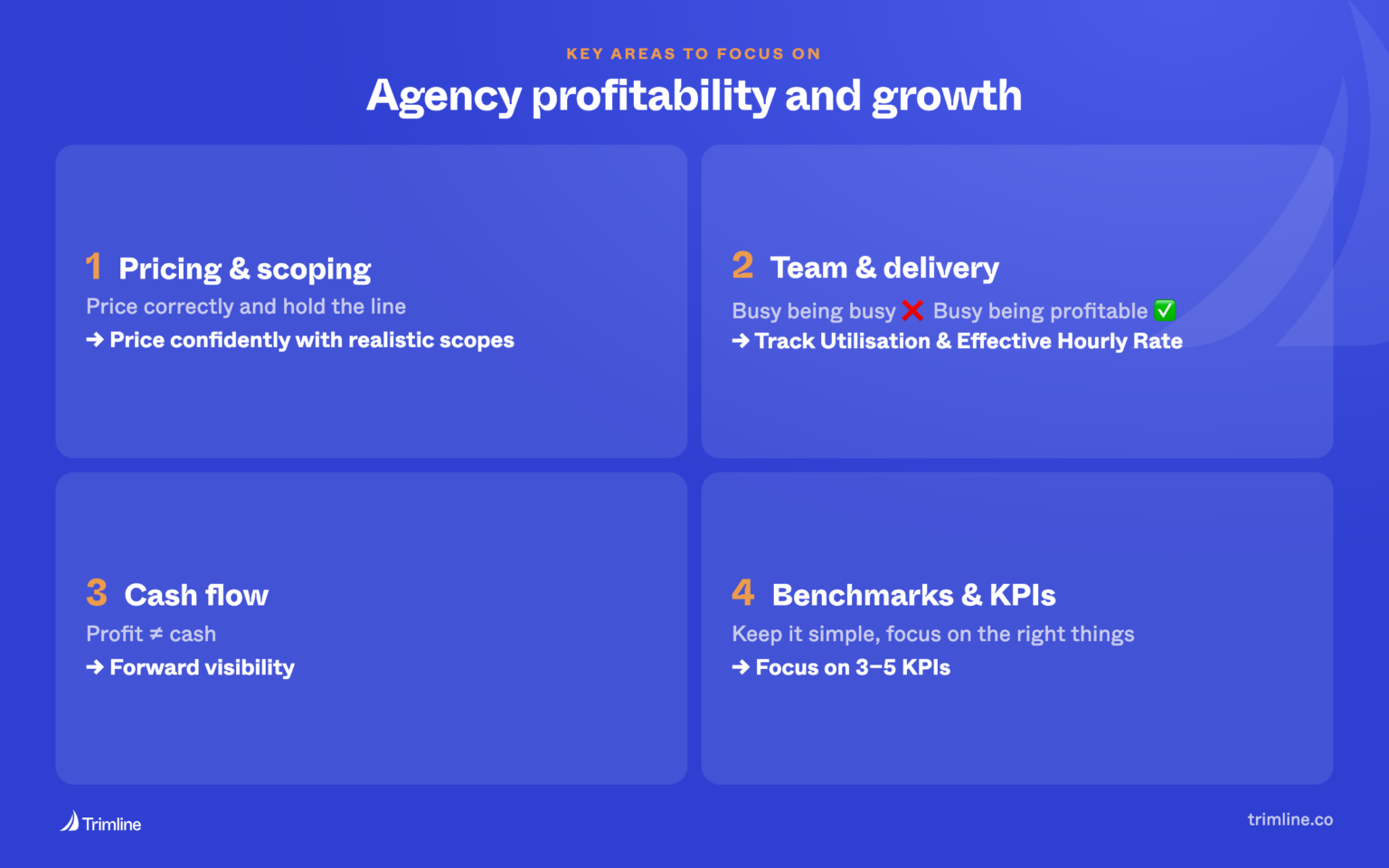
Each section tackles one major leak:
- Pricing + scope control (good rates, weak margins)
- Delivery economics (busy team, poor output)
- Cash flow control (profit on paper, stress in the bank)
- Benchmarks + KPIs (too many numbers, not enough clarity)
Start with the one that feels uncomfortably accurate.
The common thread?
Australian agencies earning $1–10M are scaling revenue, but profit isn’t following. Revenue grows. The team expands. Projects pile up. But net profit stays flat or shrinks.
You’re working harder, making bigger decisions, carrying more risk. But cash reserves aren’t building. There’s always something.. a late payment, an expense, a project that ran over.
The financial complexity is real. And most of the fixes aren’t sexy.. they’re operational.
This isn’t about frameworks. It’s about understanding where margin leaks, and what actually fixes it.

1. Why Doesn’t Revenue Growth Create Profit?
Revenue growth doesn’t create profit because most margin leaks happen after the work is sold. Over-servicing, scope creep, rising overheads and unpriced complexity absorb the gains as you scale. Plenty of Australian agencies double revenue while margins shrink. The business model, not the sales pipeline, decides whether growth turns into profit.

What Changes Between $1.5M and $5M?
Take a typical $3–7M agency I worked with recently. At $1.5M, profitability was simple.. win work, deliver it, pay yourself and five people + couple contractors. Everyone knew what everyone else was doing.
At $5M? Different game entirely.
Six clients become fifteen to twenty.
The coordination alone will kill you. Clients all work differently. Some want Slack updates twice a day. Others go dark for weeks. One of them has seven people CC’d on every email, and you’re playing “guess who actually has authority” every time you need a decision.
And the team.. when there were four of you, you just knew. Knew who was busy, knew who had space, knew what was happening. Eighteen people? You’re asking, “Who can take this?” and no one really knows. Tom thinks he’s got space. His account manager disagrees. The truth is probably somewhere in the middle, but you need an answer by 3pm, so you’re just picking someone and hoping.
Revenue’s up, but so is everything else.. your quarterly BAS payment to the ATO jumps from $15K to $65K, the software stack that cost $500/month now costs $3K, and expenses land whenever they feel like it while client payments.. don’t.
Now you’re making calls without clarity. That senior hire you need.. can you actually afford the $140K plus superannuation? The retainer that’s been running for two years.. is it profitable or is your loyalty getting in the way? Three big invoices are 45 days overdue.. how long before that becomes a problem?
You’re flying blind.
The Fake Profit Problem
A lot of agencies are running on fake profit.
The P&L might say 15%. But the founder is underpaid, absorbing scope creep, or both.
Pay yourself a proper market wage and price delivery honestly, and the “profit” often vanishes.
Thin margins remove choice. Under 10% net profit, you’re one bad quarter away from trouble.
Under 10%, you can’t hire confidently, invest in systems, or take real time off.
Profit isn’t a dirty word.
It’s what buys you time, options, and a good night’s sleep (priceless).

This is not just a numbers problem. It’s a quality-of-life problem.
In our Australian Independent Agency Report, 30% of agencies reported net profit below 10%. Only 26% cleared the 20% mark (our benchmark for a healthy, scalable business).

Download the full Australian Independent Agency Report — see how your agency compares on profitability, utilisation, and pricing.
Sustainable agencies target 15–25% net profit after paying the founder a market-based wage. That’s not greedy.. that’s creating the financial headroom to make decisions calmly, not reactively.
Extra margin = extra cash = more time = more options
If you’re not hitting those numbers, something in the business model needs to be fixed. Start there before you try to scale. Because growth without margin is dangerous.
2. Where Does Agency Margin Really Leak?
Margin leaks after the proposal is signed, not in the hourly rate. Scope creep, undisciplined retainers and quiet over-delivery erode project profitability week by week. In our 2025 survey, four out of five agencies charging above $180 per hour still reported net profit below 20%. The rate isn’t the problem. Discipline is.
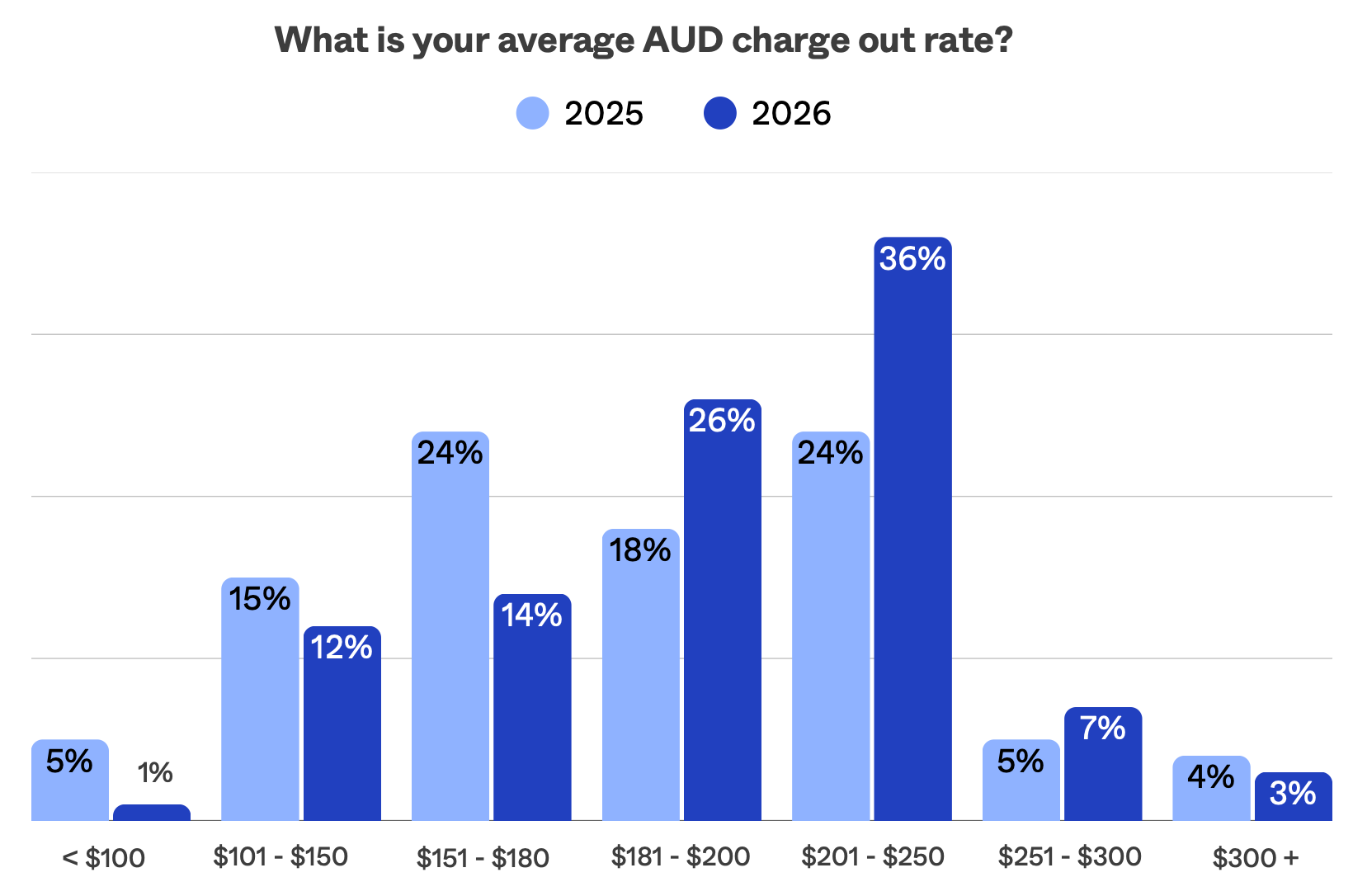
In our survey most agencies charge between $150 and $250 per hour, with an average of around $200. 47% now charge $200+ per hour, up from 33% last year. Aim closer to $250 than $200.
The Hidden Markup Rule
Your charge-out rate needs to cover more than just salaries. It needs to cover superannuation, leave, overheads, and risk, while still leaving a margin. There’s a specific multiplier that works (3.5 to 4x) and most agencies are nowhere near it.
But even agencies with solid markup formulas still report thin margins. Why? Because their estimated delivery margin at the proposal stage never survives first contact with actual delivery. Scope expands quietly, without friction.
Retainers Quietly Rot
Retainers are the dominant pricing model in Australia.. 69% of agencies in our survey use them. They create a predictable cash flow, which is brilliant. But they also create predictable scope creep.
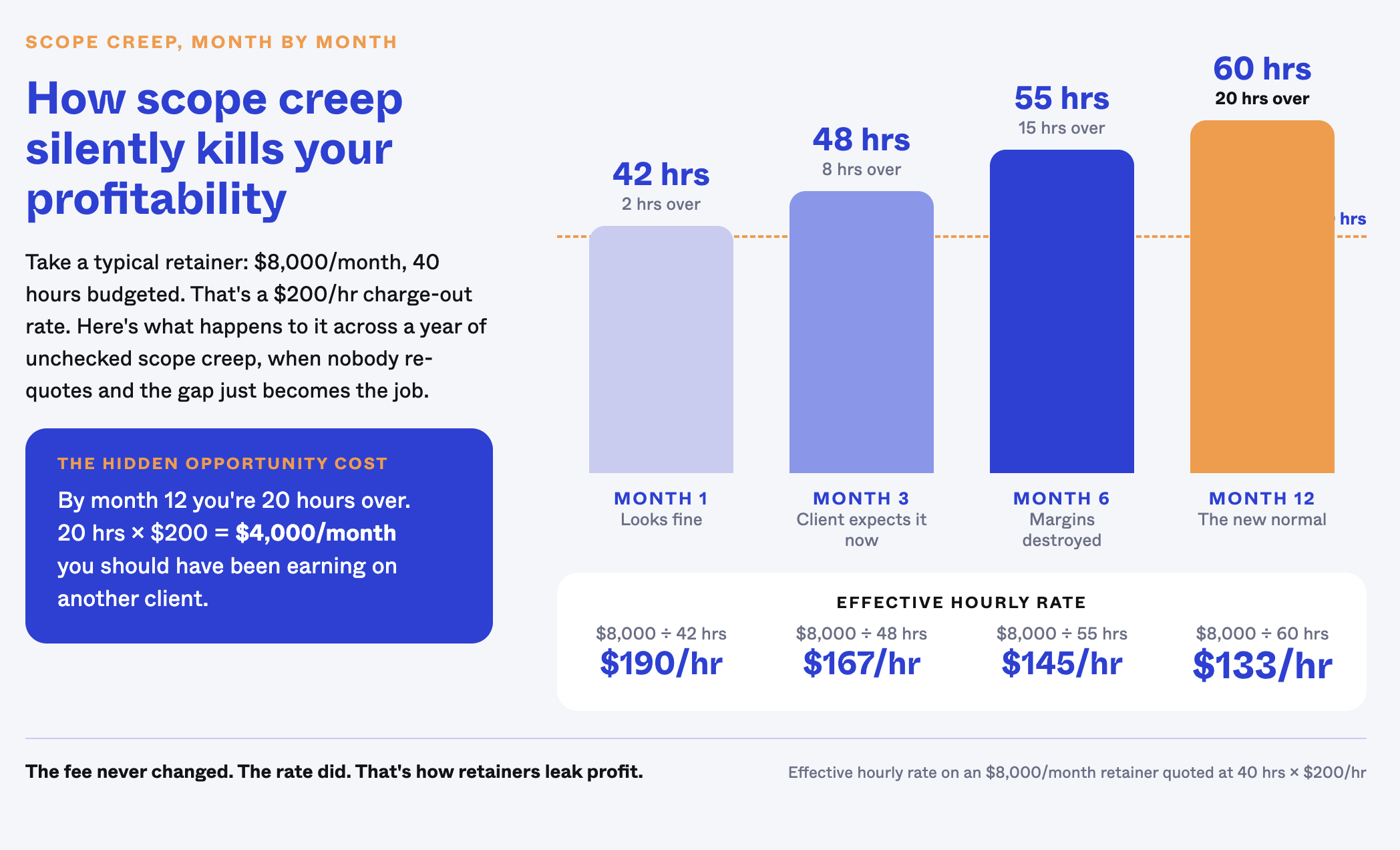
You say yes to “just one extra change” in month one. The project scope expands without friction. By month six, it’s expected every month. Same fee, more work. Margin quietly disappears, and expectations shift without anyone noticing.
One hour here, two hours there. Do that every week for a year, and your team will deliver well above what’s priced. The actual billable rate on that retainer ends up lower than what’s on the proposal.
You’re not underpricing, you’re over-servicing.
Where Discipline Actually Matters
Better pricing discipline creates more profit without adding clients or staff. That’s the lever most agencies ignore.
But what does “discipline” actually mean in practice? How do you hold the line without damaging client relationships? When should you say no? What does proper scoping actually look like?
Those answers live in the tactics.. and they’re not one-size-fits-all.
Want the full pricing playbook? Read the Agency Pricing & Scope Control Guide →
Watch: Michael breaks down the 6-step pricing system that protects your margins:
This is where agency profitability becomes a commercial reality, not theoretical numbers in a spreadsheet.
3. Why Doesn’t a Busy Team Mean a Profitable One?
A busy team isn’t a profitable team because hours don’t automatically flow to billable work. Untracked utilisation, uneven performers and premature hiring squeeze delivery margins even when pricing is right.
Operational inefficiency was one of the top challenges reported. Founders are stuck in the weeds. Projects run long. Teams are stretched.
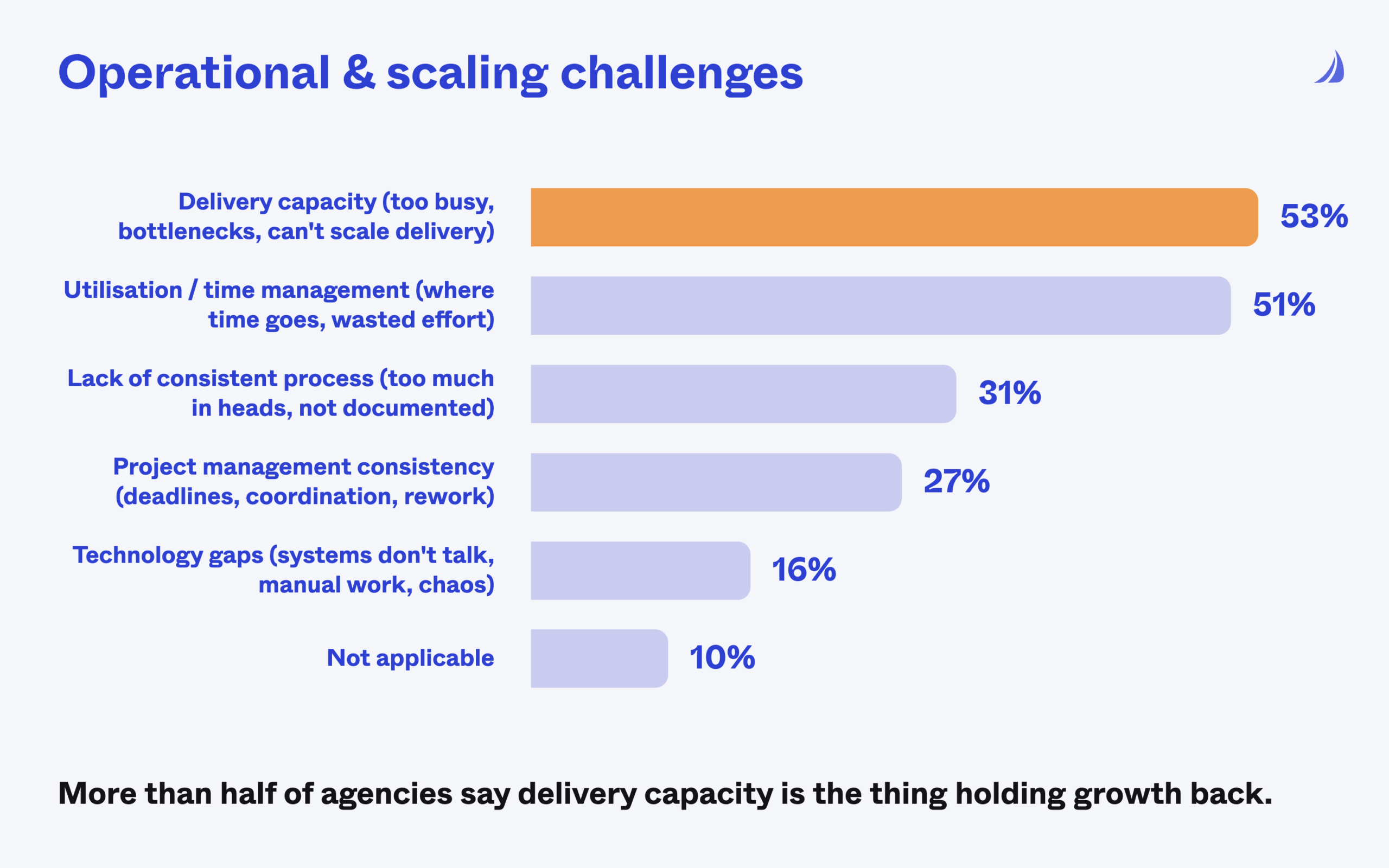
But no one’s quite sure if the hours are going to the right places.
Agencies feel this acutely. Clients judge every pixel, every deliverable.
That pressure drives overservicing, erodes delivery margins, and makes it harder to protect agency margins even when you’ve priced correctly up front.
The Utilisation Problem Nobody Tracks
In our survey 24% of Australian agencies don’t track utilisation at all, which means they’re leaving margin entirely to chance. Another 35% track it, but don’t trust the data – so probably don’t make clear decisions from it.
That means that over half don’t know (or trust) what percentage of their time is billable, internal, or wasted. If you are not doing it – get started. A simple time-tracking tool like Harvest or Toggl beats guessing.
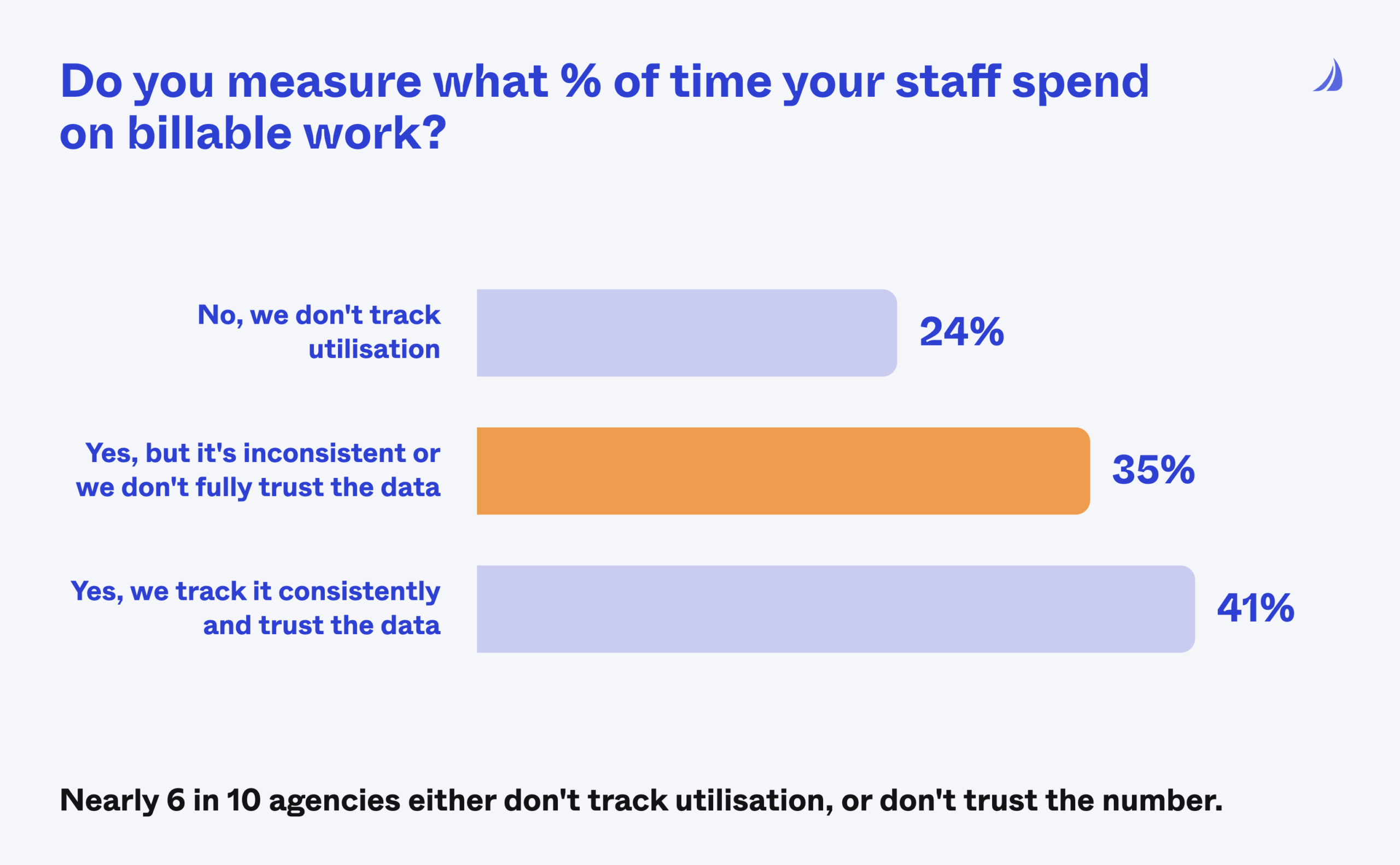
There’s a healthy benchmark.. a utilisation rate you should aim for across your delivery team (ideally 75%). But if you’re not tracking at all, you’re leaving agency margins to chance. See below current average utilisation rates across your peers:
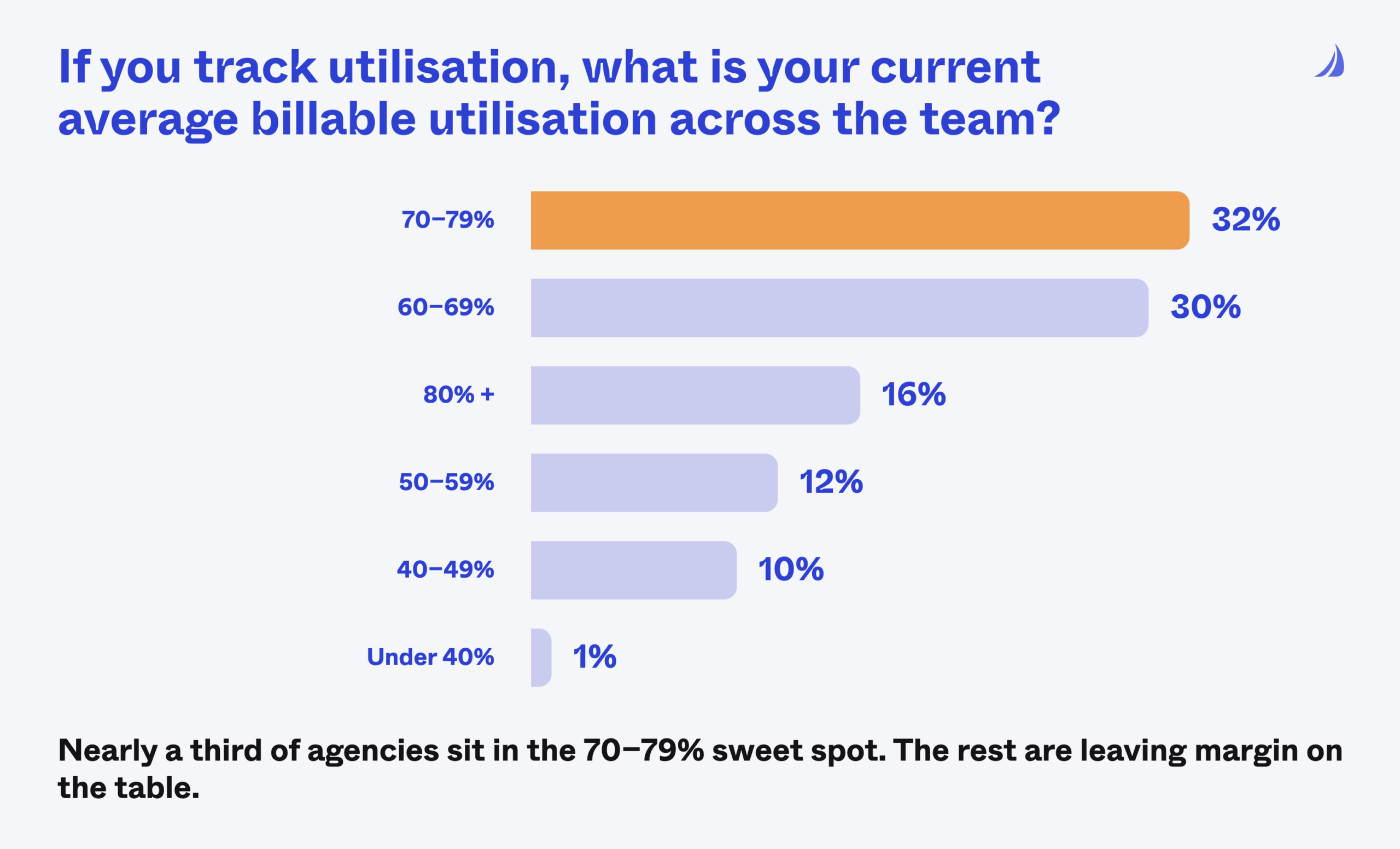
In our data, the highest-margin agencies were far more likely to track utilisation.
Not All Team Members Deliver Equal Value
You’ve got people who hit deadlines, keep clients happy, and just get on with it. Then you’ve got people who need daily check-ins and still deliver late.
Add to this that everyone is on a different wage so needs to be priced correctly.
The difference shows up in your margin. The strong performers are profitable. The weak ones are burning hours you can’t bill. High paid weak performers are one of the biggest profitability drains I see.
There’s a systematic process for this (we call it topgrading), and it reveals patterns most founders miss when they’re too close to the entire team.
Hiring Too Early Makes Margins Worse
Last year, 69% of agencies planned to grow their team. This year, 40%, the biggest shift year on year in our data.
Hiring intent is clearly down. A third of agencies are also using fewer juniors and contractors.
Part of this is AI doing more of the grunt work. Another part of it is the tougher sales environment and broader macro headwinds.
We were happy to see founders thinking twice, especially those with Profit < 10%.
You don’t fix a sinking ship by adding more crew.
If your delivery is inefficient and your team is already stretched or underutilised, hiring just adds more weight, not more momentum.
Before you hire, you need to know your current team is working efficiently on the right things. That means understanding utilisation, identifying your A Players, and building delivery systems that don’t rely on the founder.
Then you can scale with confidence.

Want the full team & delivery playbook? Read the Agency Utilisation and Charge-Out Rates Guide →

4. Why Doesn’t Profit Equal Cash?
Profit is an accounting result; cash is timing. You book revenue when you invoice, but payroll & super runs every fortnight, and BAS lands with the ATO whether clients have paid or not. An invoice sent in June and paid in August can leave a profitable agency scrambling to cover wages.
Don’t be this founder: An agency hits a profitable quarter, but the founder still can’t sleep because payroll is due in 5 days and three clients haven’t paid yet.
The Profit vs Cash Gap
Profit is revenue minus expenses in a given period. But it’s calculated on invoices you have sent, not actual cash in the bank.
Lumpy invoicing, long payment terms, pass-through expenses that temporarily drain cash, and retainers can all hide cash stress while the P&L looks healthy.
This is where founders feel the squeeze. They can’t see what’s coming next, so every decision feels risky.
What the Best Agencies Do Differently
The agencies consistently outperforming on profit share a few key cash flow practices. They’ve structured their payment terms, invoicing rhythm, and client agreements to create predictability.
There’s what we call the “gold standard”.. a specific way to structure retainers, payment timing, and media spend that fundamentally changes your cash position. It’s not complicated, but most agencies don’t do it.
For example, one simple change is having clients pay media spend directly rather than you floating tens of thousands on your credit card. This protects your agency’s gross income and keeps your cash position healthy. Another is billing upfront rather than in arrears.
But the fundamental shift happens when you can see forward. Simple visibility into the next 8–12 weeks.. what’s coming in, what’s going out, where the gaps are. That’s where light forecasting comes in, not as a complex financial model, but as a stabiliser.
Forecasting doesn’t need to be complicated. You’re not trying to predict every dollar. You just want to stop getting ambushed by payroll week when three clients haven’t paid yet.
The knot in your stomach loosens. You’re making decisions, not just hoping you’re right.
Want the full breakdown now? Download the Australian Independent Agency Report →
5. What Does “Good” Actually Look Like for an Agency?
A healthy Australian agency targets 15–25% net profit after paying the founder a market wage, tracks a small set of KPIs monthly, and prices with discipline.
Most agencies track too many numbers and miss the few that matter.
We see this constantly. Founders have dashboards with 47 metrics, but they can’t tell you their actual net profit margin, revenue per full time employee, or average utilisation rate.
The Numbers That Actually Move the Needle
Here’s what we track with clients.. a small handful of metrics that tell you if the business model is working:
| Metric | Healthy range | Warning sign |
|---|---|---|
| Net profit margin (after founder’s market wage) | 15–25% | Under 10% |
| Revenue per full time employee | Benchmark in the full KPI guide | Falling as headcount grows |
| Effective hourly rate | $190+/hour (Australian market average) | Effective rate well below proposal rate |
| Utilisation rate | Tracked monthly against benchmark | Not tracked at all |
There are a couple more, but these are the core. If you know these numbers and track them monthly, you’re ahead of most agencies.
Why Benchmarks Remove Guesswork
In our 2026 survey, the top-performing agencies (those earning over 20% net profit) shared these traits:
1. Operations under control. Most have utilisation and cost base sorted. The two biggest leaks, fixed.
2. Founder paid properly. The vast majority pay the founder a market-rate salary. If you don’t, you’re not at the margin you think you are. You’re disguising the business model and building yourself an underpaid job.
3. Still hiring. Half plan to grow headcount, against a backdrop of frozen hiring across the industry.
4. AI captured as margin. They use AI to deliver faster while holding fees, keeping the productivity gain for themselves.
And the twist: 44% of this healthy cohort have 5 or fewer staff. Fewer management layers between the founder and the work makes 20%+ margins easier to hit.
None of this requires more revenue. The profitable agencies didn’t grow their way there. They tightened their way there.
Australian agencies cluster around similar margin and utilisation issues. Knowing what “good” looks like helps you focus on the right fixes first.
You’re not comparing to feel inadequate. You’re comparing to know where to look.
If your net profit is 8% and the healthy range is 15–25%, that’s not failure. That’s a signal. Something in the business model still needs to be fixed.
If your utilisation rate is below the benchmark, you don’t need more staff. You need better delivery systems or different clients.
Benchmarks remove guesswork and help you prioritise.
Fix profitability before hiring. Fix utilisation before adding services. Fix cash flow before scaling. This is how you build a valuable, sellable business.. not just a job that pays you.
Want the full benchmark data now? Download the Australian Independent Agency Report →
6. What Does Fixing Agency Profitability Actually Look Like?
Fixing agency profitability isn’t magic. It’s operational. The agencies that break through do the boring basics consistently: they track time, price with margin built in, keep overheads lean, and review their numbers until the leaks show up. Then they fix them, one by one.
I’ve seen this pattern with dozens of agencies at this inflection point. Growing steadily, winning good clients, profit going nowhere. The turnaround never comes from a secret hack. It comes from doing the same handful of things, consistently, until the numbers move.
Here’s what that looks like in practice:
- They track time. Every hour, every client. You can’t fix what you can’t see, and margin leaks hide in untracked hours. The benchmark: every billable person hitting 75% utilisation.
- They review profitability per client and per division.. using effective hourly rate as the metric. It should equal your charge-out rate.. the gap between the two is your margin leaking. Not gut feel, not “they seem like a good client”.
- They act on what the numbers tell them. Unprofitable clients get repriced or cut, and replaced with better, more profitable ones. Painful once. Profitable forever.
- They price with margin built in. Charge-out rates never drop below the 3.5 to 4x markup floor, so every hour sold carries enough margin. And they build in annual price rises to at least match inflation.. a static rate card is a quiet pay cut.
- They mark up contractors properly. If a contractor’s on a job, there’s still margin on top of them.
- They control scope like it’s revenue.. because it is. The team is trained to spot out-of-scope work the moment it appears, and there are people assigned to have the upsell and cross-sell conversations. When everyone on the team can sell, and is encouraged to, scope creep turns into revenue instead of margin leak.
- They hold high standards for their team. Not just where the hours go, but the quality of what ships. There’s real accountability, so delivery doesn’t slip.
- They deploy senior people deliberately. They know exactly where their most expensive hours are going, and it’s profitable work.
- They keep staff cost at 50% of revenue. That’s a 2:1 revenue-to-wage ratio across the business, and 3:1 on the delivery pod. Wages are the biggest cost in an agency.. get this ratio right and the model works.
- They keep overheads lean. No ego purchases. Buy what the business needs, nothing more, and keep total overheads under 20% of revenue.
- They market consistently. The top of funnel stays full and the pipeline stays healthy.. so nobody’s making panic decisions from a position of weakness.
- They’re smart with their cash flow. Tight payment terms. Clients pay for their own media spend. And a clear process for aged receivables and debtor follow-up, so bad debts never get the chance to happen.
- They forecast before they hire. Revenue forecast drives the hiring plan, so every hire is planned, affordable, and timed.. and the cash impact is known before it hits, not discovered after. This is exactly the work a CFO does with you.
- They build cash reserves. Margins consistently above 10%, with spare cash stacking up towards 3 to 6 months of runway.
- They review their numbers regularly.. ideally with a CFO, so they stay on track and don’t quietly wander off the path of profitability.
None of this is glamorous. That’s the point.
They stopped bailing water and fixed the ship.
7. Where Should You Start?
Start with the leak that’s costing you the most right now. You don’t need to fix everything at once, and you can’t fix it all simultaneously anyway. Pick one, fix it properly, then move to the next. Most agency problems live below deck, not in the sales pipeline.
If this feels overwhelming, it shouldn’t:
- Pricing and scope control if you’re constantly underpricing or overservicing
- Team and delivery economics if people are busy but profit isn’t improving
- Cash flow and financial control (guide coming soon) if you’re profitable but anxious about cash flow
- Benchmarks and KPIs (guide coming soon) if you’re genuinely unsure what “normal” looks like
Each section breaks down one angle. Read the one that hits closest to home.
Most agency problems don’t come from a lack of revenue. They come from what’s happening below deck.. how you service existing clients, how you price new clients, and how efficiently your team actually delivers.
Margins are tight. Teams are stretched. Delivery is leaking.
Hustle might get you to $1mil, but you can’t scale chaos much past this without crashing & burning (out).
8. How Do You Move From Firefighting to Foresight?
Run the business on a rhythm, not on vibes. A monthly check of KPIs, cash timing and runway spots problems while they’re cheap to fix. A quarterly reset keeps the next 90 days honest. An annual plan gives every hiring, pricing and cash decision context. Foresight is a cadence, not a spreadsheet.
Monthly: Use the forecast to make decisions, not just admire it. Check a small set of KPIs against benchmarks, watch cash timing, and keep runway visible. The goal is simple: spot problems early, while they’re still cheap to fix.
Quarterly: Reset the game. Compare this quarter to the same quarter last year. Then ask the strategic questions: What changed? What’s working? What’s leaking margin? What needs to stop, start, or tighten for the next 90 days?
Annually: Zoom out. Set the north star and the plan, then pressure-test it with a simple 3-year view. Not a perfect prediction. A map. So growth is intentional and hiring, pricing, and cash decisions are made with context.
That’s the shift. From reactive to proactive. From guessing to knowing. From firefighting to foresight.
Why This Requires a CFO Partner, Not an Accountant
Accountants are essential. BAS, GST, compliance, year-end. They tell you what happened.
But agency profitability & growth is a forward-looking problem. Pricing. Scope. Delivery. Capacity. Cash timing.
If you’re making big calls without visibility, you’re guessing. And guessing gets expensive at $3M, $5M, $8M.
That’s what we do at Trimline as a fractional CFO for agencies. We help agency founders fix margins, stabilise cash flow, and scale without chaos.

Key Takeaways
- Growth without margin is dangerous. Target 15–25% net profit after paying yourself a market wage
- Margin leaks after the proposal is signed.. scope creep and over-servicing erode your planned hourly rate
- Track utilisation. Almost half of agencies don’t (or don’t trust it), and they’re flying blind
- Profit isn’t cash. Get 8–12 weeks of forward visibility before making big calls
- Fix the business model first. Then hire, then scale
Fix the engine. Then set sail.
If you want the benchmark data first, download our Australian Independent Agency Report.
If you want help applying it to your agency, book a call.
Agency Profitability FAQ
What’s a healthy profit margin for an agency?
Target 15–20% net profit after you’ve paid yourself properly. Under 10%? You’re one bad quarter from trouble. Over 20%? You’ve got room to breathe. I’ve had a few clients consistently over 30% net profit, but that is rare air.. elite levels.
This benchmark holds across most service businesses, but agencies face unique delivery challenges that make hitting it harder. Our 2025 survey showed that only 23% of Australian agencies cleared the 20% benchmark.. often considered the threshold for a healthy, scalable business.
How often should agencies review profitability?
Monthly minimum. Track utilisation and client profitability, spot margin issues early. Quarterly, go deeper.. analyse client mix, review pricing, review team mix. Annual reviews focus on business strategy and scenario planning. Most agencies only look backwards at Xero or MYOB. The shift happens when you start looking forward.
Can agencies be profitable while scaling headcount?
Fix what you’ve got first. If your team isn’t busy with billable work, don’t hire yet.. you’ll just have more people sitting at 60% capacity. Tighten scopes, track utilisation properly, make sure cash flow can handle another salary – then hire.
The agencies in our survey planning to hire were often the same ones struggling with efficiency.. they were scaling effort rather than results.
Why do some profitable agencies still feel cash-poor?
Because profit and cash don’t move at the same speed. You can be profitable on paper, but waiting 60 days for payments while payroll hits every fortnight. Invoice timing, payment terms, and retainer structures all affect cash flow independently of profitability. This is why cash flow and financial health deserve their own focus.. they are distinct problems that require different solutions.
What’s the difference between gross margin and net margin?
Here’s a worked example on a $100K project:
| Line | Amount | Margin |
|---|---|---|
| Project billed | $100K | — |
| Direct delivery costs (contractors, freelancers, direct tools) | $40K | — |
| Gross profit | $60K | 60% gross margin |
| Overheads (internal salaries, rent, software) | $52K | — |
| Net profit | $8K | 8% net margin |
Gross margin is project health. Net margin is business health.
PS.. the main killer to net margin I see is a bloated internal team that chews up too much revenue.
How does agency profitability compare to other professional services?
Agencies should target 15–25% net profit. Most struggle because scope expands, clients want endless revisions, and teams are expensive. Find your best services, and try to create a repeatable system to deliver.
The best agencies treat delivery like a product, not a custom service every time.
Already know your core challenge? Then you don’t need more reading.. you need help executing. If you’re ready to take action now and get more profitable, here’s how to reach me.