
Why decent rates still produce thin margins – and how to fix it.
In this guide:
- Why Do Agencies With Good Rates Still Have Thin Margins?
- Should You Raise Your Agency’s Prices?
- Why Is Your Agency Not Profitable Even With Strong Revenue?
- What Are the Main Agency Pricing Models?
- What Is the 3.5x Rule for Agency Markups?
- Why Do Estimated Margins Never Survive Delivery?
- How Do You Stop Retainer Scope From Quietly Expanding?
- How Do You Scope a Fixed-Price Project So It Holds?
- What Tools and Habits Actually Keep Scope Under Control?
- How Do You Hold Pricing Boundaries With Clients?
- What’s a 90-Day Plan to Fix Agency Pricing and Margin?
1. Why Do Agencies With Good Rates Still Have Thin Margins? (The pricing paradox)
Agencies with solid charge out rates still post thin margins because pricing only sets the starting point. Margin is won or lost after the contract is signed – in how tightly you protect scope, price by role, and track delivery hours. Fix those four things and profit follows.
Two agencies. Same $190/hour rate. Same type of clients. One is clearing 20% net profit and growing with confidence. The other is flat-out stressed and sitting at 8%.
Sound familiar?
This isn’t a rare edge case. It’s the most common pattern we see across Australian digital agencies – and the rate isn’t the problem.
Most agencies are setting sail with a leaky ship. Revenue growing, team busy, proposals going out – but the margin disappears somewhere between the quote and the delivery, and nobody can quite explain where.
Most founders assume thin margins mean they’re undercharging. So they push rates up, win a few more clients, and wait for the profit to follow. It doesn’t. Because the issue was never the number on the proposal.
Why Rate Alone Doesn’t Explain the Margin Gap
In a tightening economy, that gap gets expensive fast. Growth is harder to come by. Margin matters more. Your pricing strategy is no longer just a commercial decision – it’s a survival strategy.
But not everyone’s stuck.
There’s no shortage of content telling you which pricing model to pick – hourly vs retainer, fixed price vs value-based. Choose your fighter. That’s not what this guide is about.
But if you’re asking: remove any mention of your hours & charge out rates on quotes – just list the number so people can’t pick you apart on the details. The market is moving towards ‘output’ based pricing, not time and materials (due to AI).
This guide is about what happens after the sale. Because that’s where margin lives or dies. You can have the right model, charge decent rates, and still end up at 8% profit at the end of the year. We see it constantly.
The fix isn’t a different pricing model. It’s a different way of thinking about what you’re actually selling.
Clients don’t wake up wanting a retainer. They want a decision made. Less uncertainty. Less risk. Faster progress toward something they care about. When you position your offer around a result – with clear boundaries – the price conversation gets simpler. The scope gets easier to defend. And the margin actually survives delivery.
Here’s the shift that changes everything: your agency doesn’t sell deliverables. It sells a defined outcome with defined boundaries. The scope isn’t admin. It’s the actual product.
Stop selling hours. Start selling a defined outcome.
2. Should You Raise Your Agency’s Prices? (and how do you do it?)
Yes – pricing is the fastest profit lever you have. A price rise flows almost straight to profit because your delivery costs don’t move with it. It’s the fastest, lowest-risk way to lift margin without hiring, firing, or winning a single new client.
Pricing is the quickest profit lever in any agency. Not hiring better people, not winning more clients, not cutting costs. A price increase drops almost entirely to the bottom line, because your delivery costs don’t move just because your rates did.
The maths is that simple.
The biggest pushback I get is this: “There’s no way my old clients will pay that.”
Stop being loyal to old clients who aren’t paying you properly. That loyalty is holding you back and means you can’t afford to hire the A players that will make your life easier and take your business to the next level.
The Profit Impact of a 10% Price Lift
Say you put prices up 10% across the board. Here’s what actually happens:
- Before: $100k revenue, $80k costs, $20k profit (20% margin)
- After: $110k revenue, $80k costs, $30k profit (27% margin)
That’s a 7% increase in profit from a 10% price movement. No new clients. No extra headcount. Just a better number on the proposal.
Extra margin = extra cash = more time = more options. That’s the whole equation.
That’s why pricing is the quickest sugar hit to profitability a business can get.
What Healthy Margins Actually Look Like
Before you move rates, know what you’re targeting.
The revenue through the door gets split up each month across these core areas, and what’s left is profit.
- Cost of delivery + internal team (COGS): takes up 30–60% of revenue
- Operating expenses (OPEX): ideally under 20% of revenue
- Net profit: 20%+ left over (after paying the founder a proper market wage)
If your numbers don’t look like this, a price rise alone won’t fix it. But it’s usually the fastest place to start.
These aren’t aspirational numbers. They’re the floor for financial stability – the point where you have enough buffer to hire, invest, and absorb a rough quarter without it becoming a crisis. Below 20%, you’re not managing growth. You’re managing financial risk.

Here’s another way to think about keeping your business model in balance – you need to keep all areas in balance:

The Two Profit Levers
Two moves that shift profit fast – and both compound quickly:
- Raise prices 10–20%. Most clients won’t flinch with a 5% annual increase. 10% a few push back, occasionally someone walks. The clients who walk over a price rise usually tell you something you needed to know – they are not your ideal fit. Don’t roll out a blanket 10% for everyone. Start one by one, test and learn, and start with your most unprofitable clients.
At the bare minimum, bake in a 5% price increase annually to your contracts to help cover inflation.
- Stop donating hours. Overservicing is quiet and it’s hard to pick without accurate time data – but it’s eating your margin. Get those hours back and you actually sell them for a profit instead of pouring into a black hole.
Why Positioning Precedes Pricing
Price is just a filter. If you’re fishing in the wrong waters, raising rates won’t help. The agencies that hold premium pricing are usually the ones that have gone deep on a niche or a problem.
Specialists hold boundaries because their offer is clearer, narrower, and easier to value. Generalists get squeezed because the client can’t see where the edge is.
If you look like everyone else, you’ll get treated like everyone else.
How to Start This Week
Don’t try to reprice everything at once. Start here:
- Map your margin split. Work out your current delivery costs, OPEX, and profit using the buckets above. If you can’t see it clearly, that’s the first problem to fix.
- Pick your bottom three clients. These are the accounts where you can confidently justify a 10–15% lift. Start there, not with your biggest relationships.
- Build your pipeline first. Confidence in price conversations comes from not needing the work. A healthy pipeline makes holding the line feel easy.
- Choose one efficiency move. Identify one process change that frees up roughly 10% capacity. Usually, fewer revision rounds, tighter approvals, or a cleaner scope gate.
- Don’t fear the churn. Everyone worries that clients will leave when prices go up. They rarely do. And when they do, it’s usually the ones eating your margin anyway. Most founders dramatically overestimate the risk and underestimate the upside. Want proof?
→ Use the Client Churn Calculator
Plug in your current clients, rates, and margins. It’ll show you exactly how many clients you can afford to lose after a price increase and still come out ahead. Most agency owners are genuinely surprised by the result.
3. Why Is Your Agency Not Profitable Even With Strong Revenue?
Two agencies charging identical fees can end up in completely different financial positions. It’s almost never the rates. It’s a control problem – utilisation, effective hourly rate, delivery cost and overhead quietly decide whether pricing turns into profit or gets eaten before it reaches the bottom line.
Here’s the pattern I see over and over.
An agency can look great on paper – strong rates, confident proposals, clients happy. Then you open the books and the profit is embarrassing.
Sound familiar?
Most owners assume the rates are wrong. Usually they’re not. It’s a control problem.
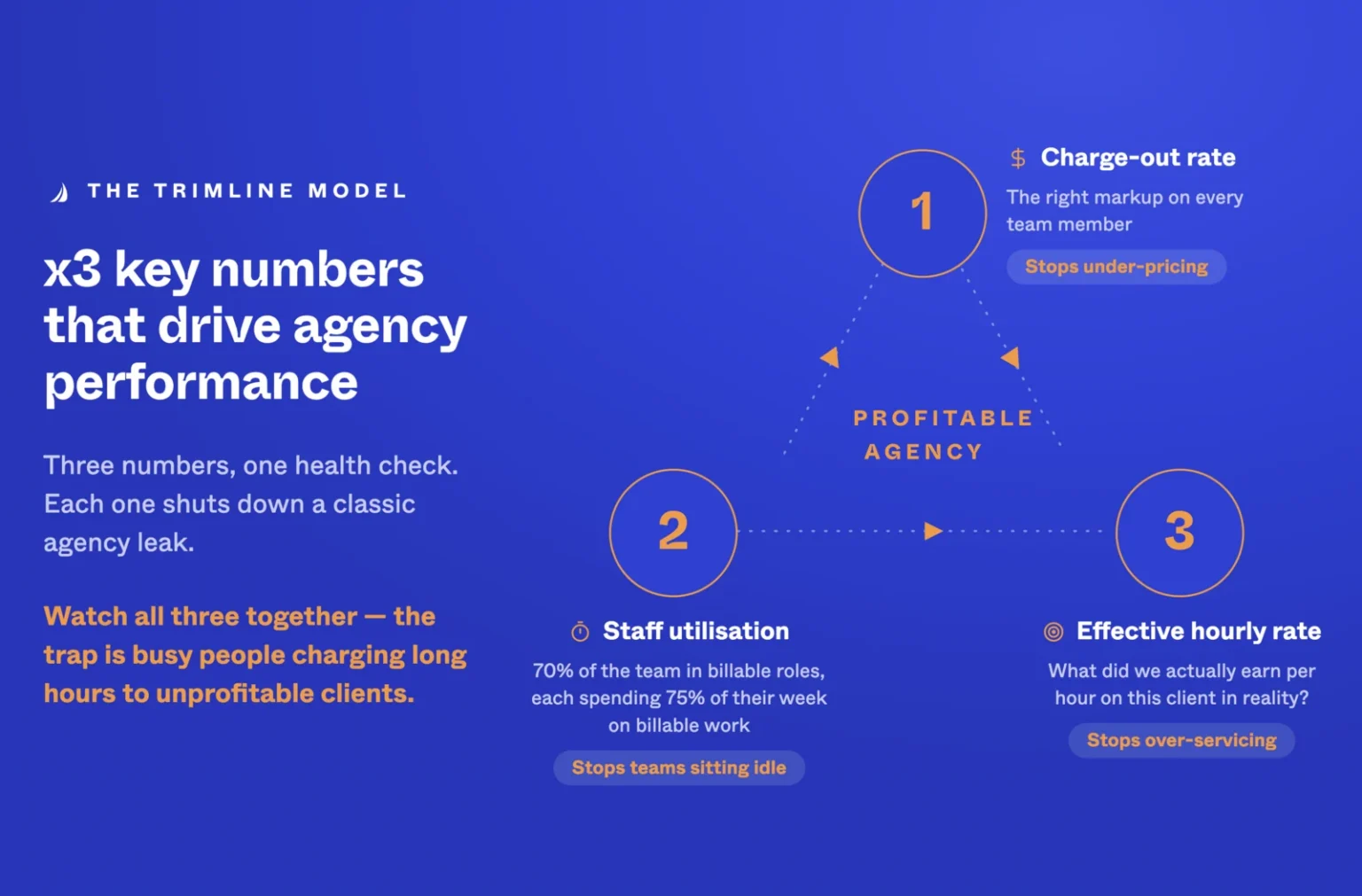
Here are the core numbers that will help you get more profitable:
1) Charge out rate: Are you building in enough margin to each hour your team work on a client?
2) Utilisation. Are you actually deploying your team’s hours on the right work, at the right level? Or are they just… busy?
3) Effective hourly rate (EHR) How many dollars are you earning per delivery hour, client by client? Most owners don’t know this number. They should.
You then need to track your overall P&L to make sure these feed into a sustainable business model:
- Overall team cost. Who’s doing the work, and what does that actually cost you once you factor in your team mix? Too many high paid people doing nothing will hurt you.
- Overhead. Tools, layers, fixed costs. The stuff that quietly eats your gross margin before it ever becomes net profit.
Pricing matters, but it only sets the starting point. Margin is won or lost in delivery – how you allocate hours, how tightly you hold scope, how you manage capacity, and whether you use the data to get smarter on the next quote. We cover the full picture in our guide to agency profitability.

Real Case Studies From Agencies We’ve Supported
Example 1: Scope Creep – A Melbourne Creative Agency
A Melbourne-based creative agency specialising in social media and content production improved its net profit by 26% over six months. When we first started working together, these were the key challenges:
- Charging out staff at around $100/hour – nowhere near enough to cover their team mix and wage costs
- Not tracking time, so no visibility on where inefficiencies were
- Service overload – the team was spread thin across too many offerings
Here’s how we fixed it:
- Raised charge-out rates gradually from $100 to $180/hour, aligned with the value delivered
- Streamlined service offerings – focused on what they were good at, what was profitable, and what the team enjoyed
- Implemented time tracking, which showed exactly where the hours were going
- Introduced a paid strategy product – initially priced at $5k, eventually raised to $15k – which improved cash flow and became a highly profitable standalone service
The result: 26% profit improvement in six months. The team was happier, staff turnover dropped, and a clear process for handling overservicing was in place.
Watch the full case study:
Example 2: Team Pay Rises Eating Margin
An SEO agency was charging $5k retainers across a long-standing client base. On the surface, things looked stable. Below the surface, the margin was quietly disappearing.
The team had been with them for years. As they grew more senior, they received pay rises – which was right and fair. But prices never moved. Every pay rise just got absorbed into costs, quietly. The same $5k retainer that worked fine with a junior team started bleeding money once the team grew.
Nobody caught it until the P&L made it impossible to ignore. The fix wasn’t complicated – reprice the retainers to reflect who’s actually doing the work now. But it should never have been left that long.
As your team gets more expensive, your pricing needs to follow suit. Loyalty to old rates is a margin leak.
4. What Are the Main Agency Pricing Models?
Most agencies run hourly, fixed-price, retainer, output (value-based) pricing, or a hybrid of a base retainer plus performance incentive. Retainers dominate the market. None of these models is inherently better – each fails the same way: nobody watches the numbers closely enough after signing.
Most agencies run on one of three core models – or a mix of all three.
Most agencies start with hourly billing because it’s easy to explain and easy to sell. The problem is it caps what you can earn and trains clients to watch the clock instead of the outcome.
Fixed-price works when scope is genuinely tight and the deliverables are clear. Predictable revenue is great – until scope creep sets in and you haven’t defined the edges well enough to push back.
Retainers dominate for good reason. 71% of Australian agencies run retainers. The cash flow alone makes it worth it. You build proper relationships and the work gets easier the longer you’re in it. Where it falls apart is when the scope quietly grows and nobody brings up the fee – because that conversation feels uncomfortable.

There are also newer models worth knowing about, particularly for agencies that can tie pricing to outcomes.
Value-based pricing works when the client can see the outcome you’re delivering and trusts you to deliver it. Perceived value isn’t about what you charge – it’s about what they believe they’re getting. That’s a positioning conversation before it’s a pricing conversation.
A hybrid approach – base retainer plus a performance incentive tied to revenue generated – gives you two revenue streams working at once. It aligns your incentives with the client’s and requires trackable metrics, solid data, and a high-trust client relationship – but the margin upside is significant.
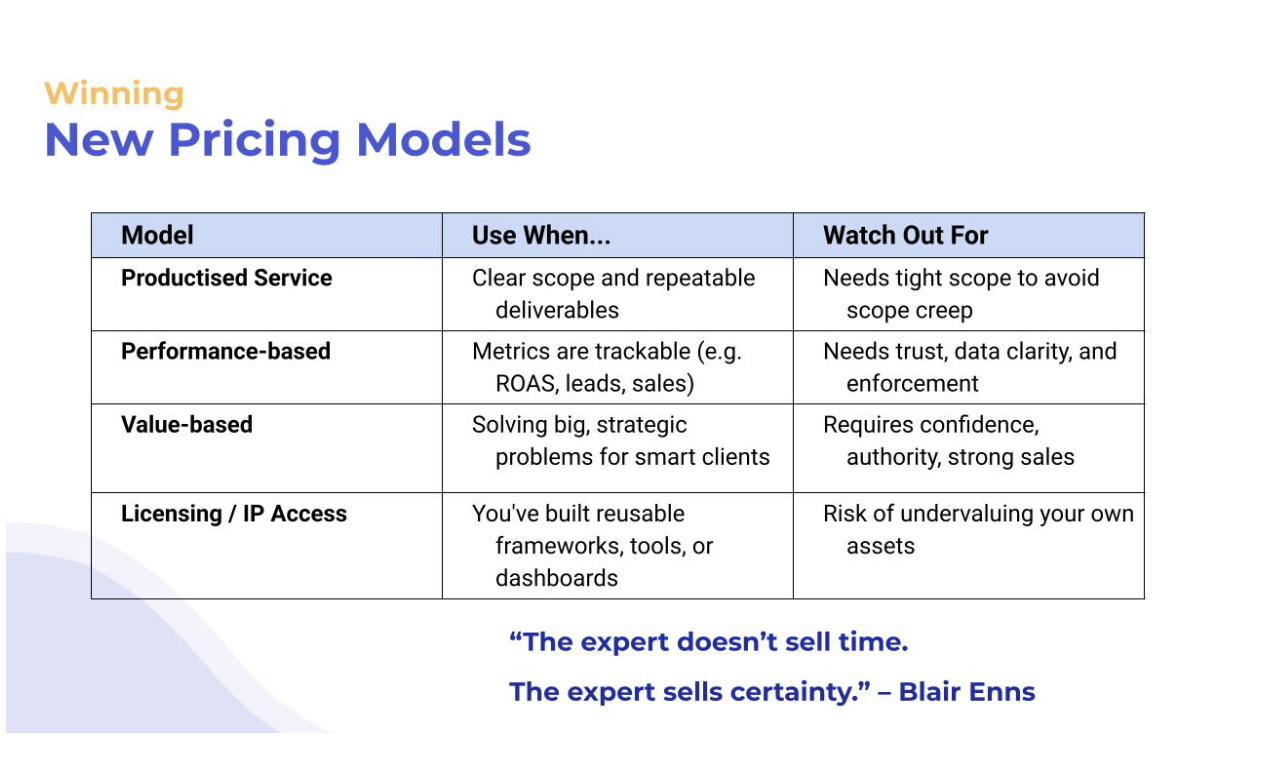
Any of these models can work. Most fail because nobody’s watching the numbers closely enough. The right pricing model for your agency isn’t the one that sounds best in a pitch – it’s the one your team can actually protect after the contract’s signed.
5. What Is the 3.5x Rule for Agency Markups?
Take a team member’s real hourly cost, including super, and mark it up at least 3.5x – closer to 4x for senior roles. That’s not a ceiling, it’s the floor. The old rule of thirds (3x) no longer covers today’s wages and overheads and quietly caps net profit under 10%.
As a rule of thumb:
- Calculate a team member’s real hourly cost
- Mark it up at least 3.5x
- For senior roles, aim closer to 4x if you can
And it’s the minimum benchmark for sustainable agency compensation – if you’re not covering your true cost of delivery and leaving something for the business, you’re effectively subsidising your clients.
The old rule of thirds was a reasonable starting point. Charge 3x what someone costs and you should be fine. The problem is wages have gone up, overheads have gone up, and the work itself is more complicated than it used to be.
A straight 3x today often gets you to under 10% net profit once you look at the whole picture. That’s not a business. That’s a grind.
See the Numbers – What 3.5x Looks Like by Role
Here’s how the numbers look across three common roles, using real salary benchmarks with superannuation included:
| Role | Cost/hr | Min Charge-out (×3.5) | Stretch (×4) |
|---|---|---|---|
| Strategist | $85/hr ($150k + super) | $298 | $340 |
| Account Manager | $57/hr ($100k + super) | $198 | $227 |
| Technician | $45/hr ($80k + super) | $159 | $181 |
Most agencies don’t know their floor – and they’re undercharging without realising it.
One Blended Rate Will Quietly Kill Your Margin
If you use one average charge-out rate across the whole business, you will lose margin over time.
Because people get promoted, costs rise. Your pricing doesn’t automatically rise with it. A senior strategist being sold at a junior rate is expensive. And it compounds.
Tiered rates matter: junior technicians at one level, mid-level at another, senior and strategic at another.
If your senior people are being sold at junior economics, your business will feel busy and broke forever. You can’t afford the pay rises your team deserve and staff will get frustrated.
6. Why Do Estimated Margins Never Survive Delivery?
Margin dies in the gap between what you quoted and what actually got delivered. Scope creeps, extra meetings happen, hours go unlogged. Your real input to margin isn’t the quoted rate or the pricing model – it’s the actual hours spent divided into the fee, client by client.
Knowing your hours per client is the real input to margin. Not your quoted rate. Not your pricing model. The actual hours spent delivering, and what you’re earning per hour of that time.
So here’s the question: what is your actual effective hourly rate?
Pull the hours your team logged against a client, divide the fee by that number, and see what you get. Most agency owners are surprised. Usually not in a good way.
Sound familiar? That’s because most agencies are flying blind on this. They quote on gut feel, deliver on goodwill, and wonder why the profit never shows up.
That’s not a pricing issue. It’s a delivery issue.
Here’s how we track it for our clients, across each client per month vs our goal effective hourly rate.

Anything below the line, we are potentially overservicing and need to investigate.
The Overservicing Spiral
The pattern usually comes from fear, not incompetence. A client seems unhappy and you say yes. Then yes again. Hours climb, EHR quietly drops, cash gets tight – and the fear gets worse. Getting scope under control is usually what stops it.
Not Every Client Deserves the Same Care
Agencies overservice small accounts because it feels like the right thing to do. It isn’t. If you’re burning hours on a small retainer, that’s unpriced busywork. And if delivery only feels worth it when the team pulls heroics, the model is broken – not the pricing.
Start tracking hours by client. I’ve yet to meet an agency owner who looked at their real per-client earnings and didn’t wince. Usually goes quiet for a bit after that.
7. How Do You Stop Retainer Scope From Quietly Expanding?
Retainers rarely blow up all at once. You look up one day and realise you’ve absorbed months of work that was never in the original agreement, while the fee stayed the same. The fix is a monthly rhythm: written scope, an hours-logged-versus-estimated review, and a clear process for extras.
Retainers exist because long-term client relationships are worth something – to you and to them. Ongoing work gets easier, the brief gets tighter, and the trust compounds. The problem isn’t the model. It’s what happens when that goodwill becomes a reason to absorb scope quietly instead of holding the line.
But the fee never moved. And that’s how it happens.
A better contract won’t solve it. What actually helps is building a rhythm where scope gets reviewed regularly and the conversation about fees isn’t a big awkward event – it’s just normal.
- Set the scope in writing, every time. What’s included, what’s not, and what triggers a change request. If it’s not written down, it’s a favour.
- Run a monthly retainer review. Look at hours logged versus hours estimated. If you’re always over, the retainer is too cheap. That’s worth saying out loud to the client rather than just eating it.
- Clear process for extras. A change request process mostly just stops you from quietly resenting work you’re doing for free.
Retainers rot when overhead quietly grows and nobody recalculates the minimum fee. The discipline isn’t in the proposal. It’s in what you do every single month after it’s signed.
The core principle: you can structure your retainer any way you want, as long as you’re applying the right markup for each person – relevant to what you’re paying them – and accurately estimating the hours for each piece of work.
Retainers billed in arrears with expanding scope are also cash flow problems waiting to happen. If you want to manage cash flow without winning new clients, start with billing. Getting even one month’s retainer paid upfront is one of the fastest structural improvements you can make.
8. How Do You Scope a Fixed-Price Project So It Holds?
Fixed-price projects usually fail for one of three reasons: no single person owns the scope, changes sneak in without a commercial conversation, or overruns get caught too late. Appoint a scope lead, build sign-off milestones between phases, and run a weekly pacing check against the hours budgeted.
Fixed-price projects don’t usually fall apart in one moment. It’s more that the scope shifts a bit, nobody pulls it up because it doesn’t feel worth the conversation, the team absorbs it, and you finish having done more than you quoted.
Most agencies just chalk it up to keeping the client happy.
The Three Most Common Scoping Problems
1. No single person owns the scope. Everyone assumes someone else will push back. Without a clear owner with the authority and mandate to say no, scope control is just a sentence in the contract that nobody reads.
2. Changes sneak in without a commercial conversation. New stakeholders appear. Priorities shift. The changes feel small in isolation, so nobody flags them as billable. Do that every week for three months, and your margin is gone.
3. Overruns are discovered too late. At 50% of the timeline, you should have spent roughly 50% of your hours. If you’re at 70%, something needs to change now – not at the final invoice.
The Solutions That Actually Work
- Appoint a scope lead. One senior person owns scope on every project. When something starts to drift, the team knows who makes the call and that person has enough authority to actually make it.
- Build one-way door milestones. Before each phase closes, get the client to actually sign off. It feels formal the first time you do it, but it protects everyone. If they want to revisit something after that point, it’s a new piece of work. Most clients get it once you walk them through it.
- Run a weekly pacing check. Every week, sit down with hours logged versus hours budgeted. Catching an overrun at 60% means you can still do something about it. At 110% you’re just doing the maths on how much you lost.
- Use a menu, not a negotiation. Before the project starts, agree on what’s in and what costs extra. When something new lands mid-project, you’re not making a judgement call on the spot. You’re just pointing at the list.
- Build a change request playbook. When scope shifts, write it down. Here’s what changed, here’s what it costs or what we’ll drop to make room, here are the options. Takes about ten minutes and saves a lot of painful conversations later.
These are the patterns we see most often, but far from the only ones. Through working with agencies across Australia, we’ve built up a library of scoping scenarios, fixes, and real examples that go much deeper than we can cover here. If scope creep is already costing you margin, book a call with Trimline and we’ll walk through your specific setup.
Scope control isn’t about being difficult. It’s about protecting the result you both agreed to deliver.
9. What Tools and Habits Actually Keep Scope Under Control?
Scope control isn’t a software problem, it’s a habits problem – five of them: minimum viable time tracking, weekly pacing checks, a monthly client review, a clear escalation path, and change request hygiene. Client expectations and scope creep are consistently among the top profitability drains we see in agencies.
Most agencies have a scope policy somewhere. Usually in a folder nobody opens. What actually works is making scope part of the weekly rhythm so it never becomes a big conversation in the first place.
You can’t scale chaos. The agencies that get this right don’t do it with better software. They do it with better habits.
Five Habits That Actually Keep Scope Tight
- Minimum viable time tracking. A few simple buckets that match how you quote. Don’t over-engineer it or everyone dumps their time into ‘admin’ and the data becomes useless. Simple and consistent beats sophisticated and ignored.
- Weekly project pacing. A quick check of hours logged versus hours budgeted. Course-correct mid-project, not at the end. This is the earliest warning system you have.
- Monthly client review. Effective hourly rate trend, top hours-drainers, and a scope creep log. Three numbers, once a month. That’s enough to spot the problems before they compound.
- Clear escalation path. Delivery staff don’t say no to clients. They handball to an account manager or team leader who has the authority and context to handle the scope conversation. Take the pressure off the technicians.
- Change request hygiene. Every request gets logged somewhere visible, labelled as comped, quoted, or a re-scope trigger. Not to create bureaucracy – to create a paper trail that protects your margin and keeps everyone honest.
This isn’t about monitoring your team. It’s about building a system that surfaces problems early enough to fix them.
The goal is trusted data and early warnings, not surveillance.
Your team needs to understand why this matters – accurate time tracking means better pricing, healthier workloads, and protected margin. When people understand the why, the habits stick. If you’re starting from scratch, here’s our guide to implementing time tracking for your team.
The Tools That Work (and Why the Tool Isn’t the Problem)
The number one rule with any tool: dirty data in, useless tool out. The best project management software in the world won’t help if your team isn’t logging time accurately and consistently. Before you invest in new tooling, invest in the habits and accountability that make the data trustworthy.
If you’re thinking about switching tools, don’t do a full cutover straight away. Run a beta test with one team or a handful of clients first. Work out the kinks before you commit.
For project management and utilisation tracking, a few tools consistently come up in our work with agencies:
- Productive.io – handles budgets, resourcing, and utilisation in one place. Solid choice if you want everything connected.
- Teamwork – simpler and easier to implement for smaller teams. Good starting point.
- ClickUp + Everhour – a popular combination when you want flexible project management with time tracking layered on top.
Xero is the accounting standard. Pair it with Ignition for proposals and automated billing if you want to clean up your invoicing workflow.
Some other common options:
Project management: Scoro, Teamwork, Productive.io, ClickUp + Everhour, Accelo, Asana, Trello, Active Collab, Notion
Time tracking: Toggl, TopTracker, Harvest (or just direct in project management software)
Pick what your team will genuinely use. Worry about upgrading when you’ve actually outgrown it.
10. How Do You Hold Pricing Boundaries With Clients?
Saying no feels risky. It isn’t – the real risk is saying yes to everything and building a business that can’t turn a profit. The agencies that hold boundaries comfortably are the ones where no single client can sink the business: five or six solid accounts, none irreplaceable.
Scope creep doesn’t just hurt your margin. It hurts the work. The team gets stretched, corners get cut, and the client ends up unhappy anyway. You’re not doing anyone a favour by absorbing it.
A simple script that actually works: “To keep the results where we want them, we do X. If you need Y, that’s a change request.” Say it plainly, don’t apologise for it, and most clients just move on.
What You’re Accountable For (And What You’re Not)
Higher rates mean you’re genuinely on the hook for the work and how you run it. But late approvals, a brief that changed twice, a budget that was optimistic from day one – those were never yours to absorb. You can be professional and still say that out loud.
The Whale Client Trap
I’ve seen it time and again. An agency builds its whole model around one or two large clients. And those whales are almost always the least profitable accounts in the business.
Why? Because the agency is terrified of losing them. So they overservice. They say yes to every request. They absorb scope creep. They discount. They put their best people on the account and charge as if they’re juniors.
And then the client churns anyway. Because everyone churns eventually.
When that happens, it’s a crisis. The revenue hit is massive. The team is devastated. And looking back, the agency wasn’t even making good money on them – they were just too scared to hold the line.
I’ve helped some clients through some pretty dire situations over the years. A whale client worth 20 to 30% of their entire book churns, and we immediately have to think about restructuring the team.
The better model: five or six solid clients, none of whom can sink the ship on their own. You can say no. You can hold the scope. You can price properly. And when one leaves, it hurts a little rather than a lot. You don’t want any one client above 15–20% of your overall revenue.
A client mix where any one client is replaceable is a strong and de-risked place to run your business + it makes it more valuable to a buyer.
Boundaries Only Work When You Can Walk Away
Scope control isn’t a script. It’s a power position. If you can’t afford to lose a client, you can’t hold the line with them.
The goal is a client mix where any single client is replaceable. Use this as your decision rule:
- If they need miracles to make your fee feel fair, walk away.
- If they can win comfortably at this price, you can hold boundaries comfortably.
If the client can’t win at your rates, they’ll always resent it. That’s not a client relationship. It’s a slow-motion breakup – and it’s usually expensive on the way out.
11. What’s a 90-Day Plan to Fix Agency Pricing and Margin?
Four steps, run in order: price it properly, protect the scope, track capacity, close the loop. Days 1–30 get the economics right. Days 31–60 stop the leaks. Days 61–90 compare quoted hours to actual and adjust. None of it is a big swing – it just compounds fast.
Most agencies try to buy their way into professionalism – building out their tech stack and team structure before the margin is actually there to support it. Better to start with less, figure out where the real bottlenecks are, and spend money there.
This stuff doesn’t need to be a big project. Most of it is just changing a few habits.
The Trimline Profit Flywheel
Here’s how it works in practice: four steps, each one building on the last.

- Price it properly (set the economics). Test a 10–20% lift on new proposals. Stop blending senior thinking into cheap delivery rates. State your assumptions clearly so clients know exactly what they’re buying.
- Protect the scope (stop drift). No change request, no extra work. If the same scope problem keeps happening, it’s not bad luck. It’s a broken system. Fix it once.
- Track capacity (make busy measurable). The one number worth tracking: effective rate per client – revenue divided by hours spent. It tells you which clients are buying your week and which retainers are quietly unprofitable.
- Review & adjust (use delivery data to update future pricing). Quote, track, compare, adjust. Keep time tracking in 4–6 buckets that match how you quote. If your quotes aren’t getting smarter over time, you’re guessing. And guessing is expensive.
The Controls are your dashboard – the numbers that tell you where margin is leaking. The Flywheel is your operating cadence – the four steps you run consistently to fix it. One tells you what’s wrong. The other is how you put it right.
Your 30/60/90 Day Plan
Days 1–30: Get the economics right.
- Audit your rates against the 3.5x markup rule
- Map your margin split – delivery costs, OPEX, net profit
- Identify your bottom three clients and build the case for a price increase
- Test a 10–20% lift on all new proposals
Days 31–60: Stop the leaks.
- Implement a basic change request process
- Appoint a scope lead on every active project
- Start tracking hours against budgets weekly
- Run your first monthly client review – effective hourly rate trend, top hours-drainers, scope creep log
Days 61–90: Close the loop.
- Compare quoted hours to actual hours on three completed projects
- Identify where the margin went and why
- Adjust proposals – tighter scope, better buffers, different team mix
- Review which clients are actually profitable and which need a conversation
The maths doesn’t lie – small, consistent moves compound quickly.
→ Watch the Trimline Profit Flywheel Webinar
Final Thoughts on Agency Pricing and Scope Control
Most agencies don’t have a pricing problem. They have a discipline problem.
The rate on your proposal doesn’t determine your margin. It’s what happens after the proposal is signed – how tightly you hold scope, how accurately you track hours, and whether you use that data to get smarter on the next quote.
You’re not undercharging. You’re overservicing.
Key takeaways:
- Pricing sets the starting point. Margin is won or lost in delivery, after the contract is signed.
- Mark up real hourly cost at least 3.5x (closer to 4x for senior roles) – that’s your floor, not your ceiling.
- Track your actual effective hourly rate per client. It’s the real number, not your quoted rate.
- Scope control is a habits problem, not a software problem – five habits, run weekly and monthly.
- A client mix where no single account can sink the business is the only position you can hold boundaries from.
The fix isn’t complicated. Price properly, protect the scope, track capacity, and close the loop. Do those four things consistently, and the margin follows.
The agencies pulling 20%+ profit aren’t doing anything revolutionary. They’re doing the boring basics, consistently. Tight scopes. Clean data. Regular reviews. A team that understands the commercial reality of the work they’re delivering.
Fix the engine, then set sail. Get the model right first – then scale it.
If this guide has hit close to home, good. It means there’s something worth fixing – and it’s fixable.
Want to Find Where Your Margin Is Actually Leaking?
If you want to fast-track the process and work through it with an experienced fractional CFO, that’s exactly what we do at Trimline. We help Australian agency founders fix margins, tighten delivery, and scale with confidence rather than chaos.
Book a call with Trimline. No sales pitch. Just a straight conversation about where your margin is leaking and what to fix first.